International Symposium on Grids & Clouds (ISGC) 2026
BHSS, Academia Sinica
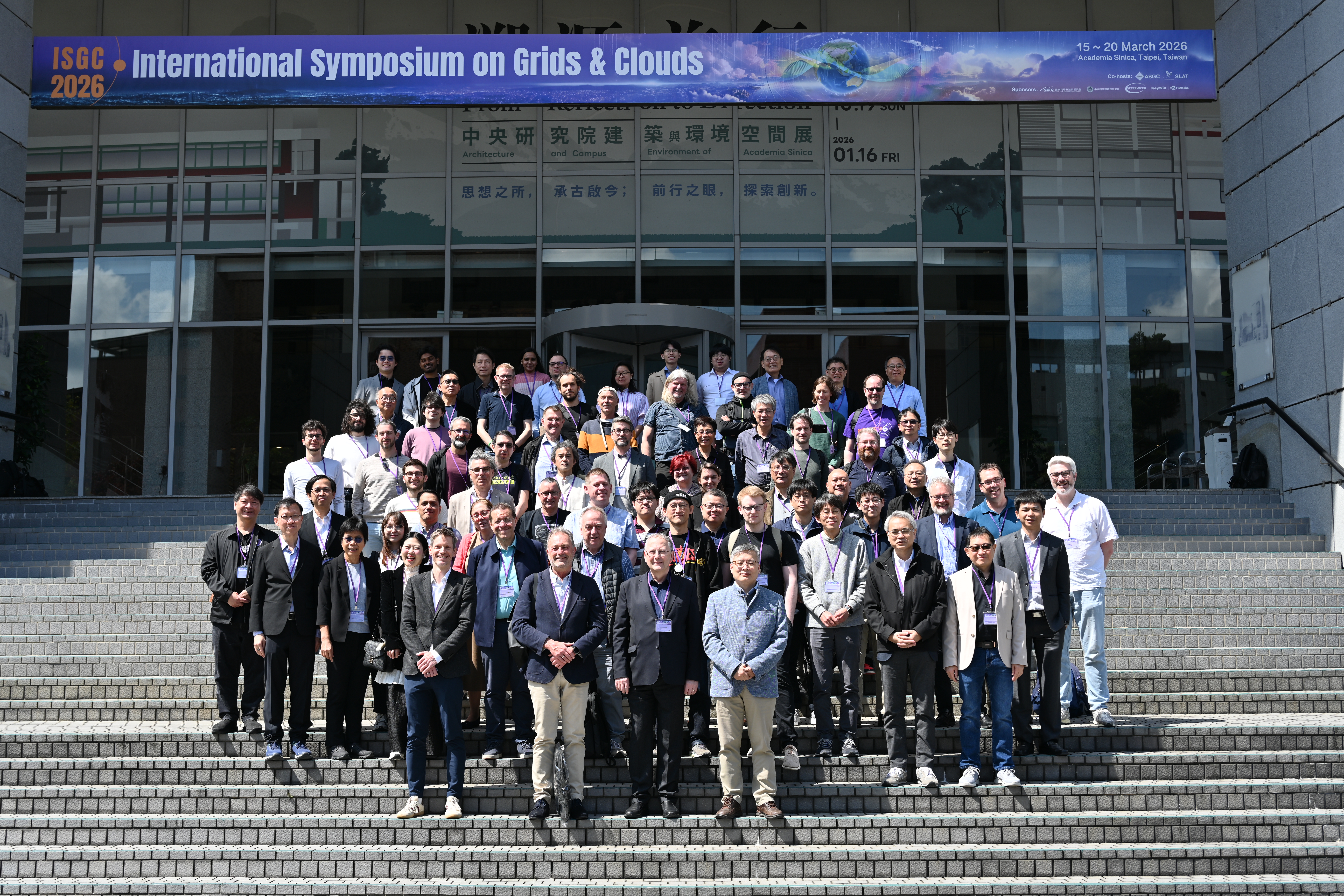

The exponential growth of research data is reshaping the scientific landscape. What once came mainly from controlled experiments is now complemented by continuous streams from sensors, simulations, and digital interactions. A central focus is the need for trustworthy and sovereign data ecosystems that allow researchers to retain control over sensitive resources while enabling collaboration across disciplines and borders. At the same time, the rise of AI-driven discovery and decision-making places new demands on data quality: models require information that is not only accurate but also transparent in origin, rights, and conditions of use.
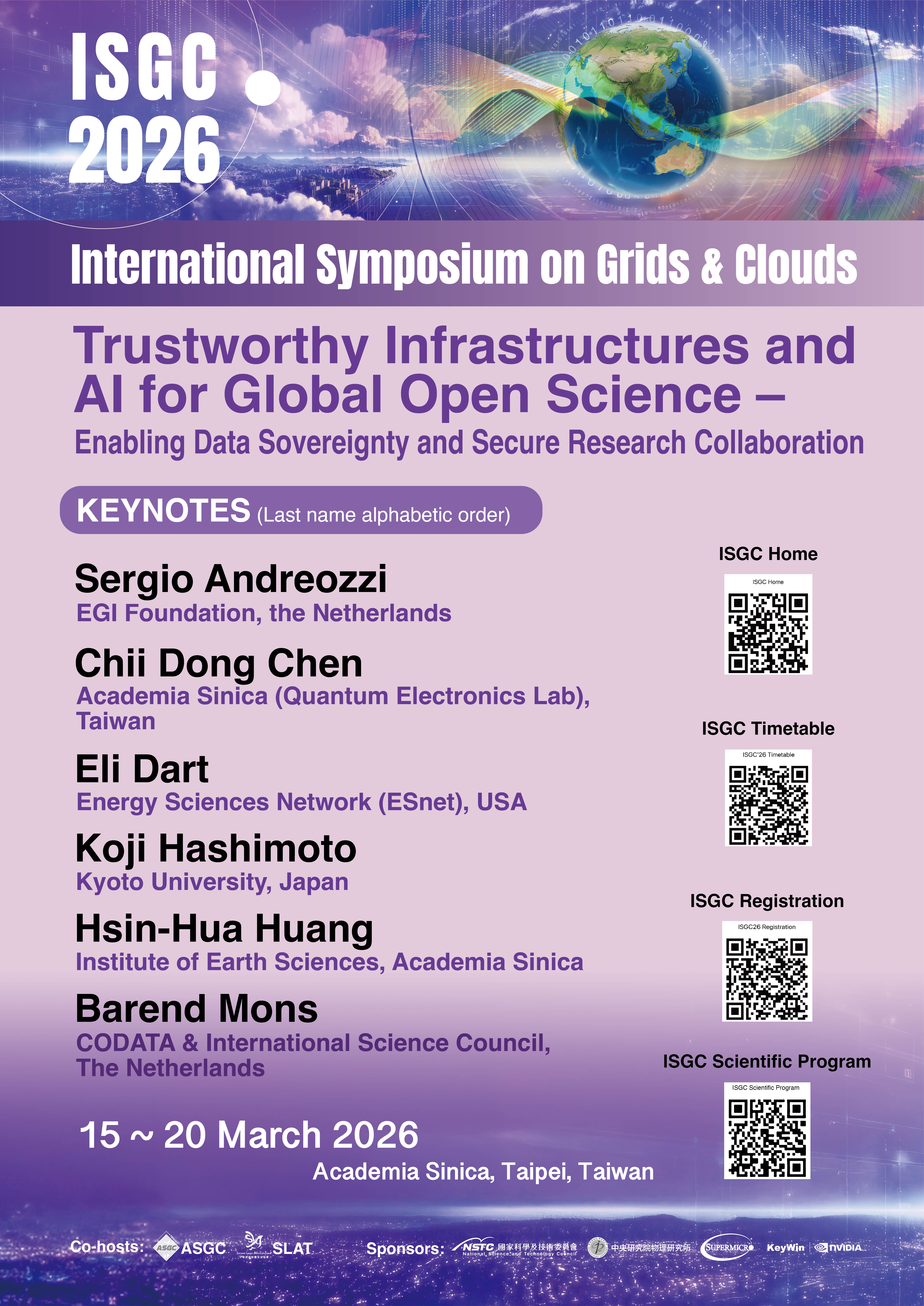
ISGC 2026 will focus on the theme “Trustworthy Infrastructures and AI for Global Open Science – Enabling Data Sovereignty and Secure Research Collaboration”, addressing pressing issues such as Artificial Intelligence (AI), Security, Data Sovereignty, Open Science, Research Infrastructures, Ethics of Computing, Societal Impacts, Misinformation and Disinformation, Sovereign Capabilities, Global Collaborations, and Science for a Sustainable Future. Bringing together leading experts from academia, research infrastructures, and industry, ISGC 2026 explores how emerging technologies—from AI and quantum-enhanced computing to big data analytics—can shape a trustworthy and sustainable future across disciplines.
The program spans 10 scientific topics: Physics & Engineering Applications, Health & Life Sciences, Earth & Environmental Sciences & Biodiversity, Social Sciences & Humanities, Virtual Research Environments, FAIR & Trusted Data, Networks & Security Infrastructures, Cloud & Virtualization, Converging High-Performance Computing, and Artificial Intelligence (AI). Through keynotes, workshops, international project reports, and peer-reviewed contributions, ISGC 2026 continues to strengthen global collaborations, cultivate future scientific leaders, and bridge cutting-edge technologies with societal responsibility.
We warmly invite the global research and industry community to join this premier event where innovation, trust, and international collaboration meet to shape tomorrow’s breakthroughs.
-
-
09:00
→
10:30
Closed Group Meeting Conference Room 2 (BHSS)
Conference Room 2
BHSS
Convener: Eric YEN (Academia Sinica) -
10:30
→
11:00
Coffee Break 30m BHSS, 3F
BHSS, 3F
-
11:00
→
12:30
Closed Group Meeting
-
12:30
→
14:00
Lunch (4F) 1h 30m
-
14:00
→
15:30
Closed Group Meeting Conference Room 2 (BHSS)
Conference Room 2
BHSS
-
09:00
→
10:30
-
-
09:00
→
10:30
CryoEM & ASCEM Workshop Conf. Room 1
Conf. Room 1
BHSS, Academia Sinica
Conveners: Prof. Shang-Te Danny Hsu (Institute of Biological Chemistry, Academia Sinica) , Dr Piotr Draczkowski -
09:00
→
10:30
Security Workshop: (1) Security Workshop Introduction, What to protect (IT Security for complex infrastructures); (2) IT Security, Where to start, what to protect and how (Introduction to IT Security Risk Management) Conference Room 2
Conference Room 2
BHSS, Academia Sinica
https://indico.egi.eu/event/6935/timetable/#all
Conveners: David Crooks (UKRI STFC) , Sven Gabriel (Nikhef/EGI) , Daniel Kouril (CESNET / Masaryk University) , David Groep (Nikhef and Maastricht University) , David Kelsey (STFC-RAL) , Barbara Krasovec (Institute Jožef Stefan) -
10:30
→
11:00
Coffee Break 30m
-
11:00
→
12:30
CryoEM & ASCEM Workshop Conf. Room 1
Conf. Room 1
Conveners: Prof. Shang-Te Danny Hsu (Institute of Biological Chemistry, Academia Sinica) , Dr Piotr Draczkowski -
11:00
→
12:30
Security Workshop: (1) IT Security, Where to start, what to protect and how (IT Security Risk Management); (2) Building a defensible IT Infrastructure, Protection and Prevention (Security Architecture fundamentals) Conference Room 2
Conference Room 2
BHSS, Academia Sinica
https://indico.egi.eu/event/6935/timetable/#all
Conveners: David Crooks (UKRI STFC) , Sven Gabriel (Nikhef/EGI) , Daniel Kouril (CESNET / Masaryk University) , David Groep (Nikhef and Maastricht University) , David Kelsey (STFC-RAL) , Barbara Krasovec (Jožef Stefan Institute (JSI) /EGI) -
12:30
→
14:00
Lunch (4F) 1h 30m
-
14:00
→
15:30
CryoEM & ASCEM Workshop Conf. Room 1
Conf. Room 1
Conveners: Prof. Shang-Te Danny Hsu (Institute of Biological Chemistry, Academia Sinica) , Dr Piotr Draczkowski -
14:00
→
15:30
Security Workshop Conference Room 2
Conference Room 2
BHSS, Academia Sinica
https://indico.egi.eu/event/6935/timetable/#all
Conveners: David Crooks (UKRI STFC) , Sven Gabriel (Nikhef/EGI) , Daniel Kouril (CESNET / Masaryk University) , David Groep (Nikhef and Maastricht University) , David Kelsey (STFC-RAL) , Barbara Krasovec (Jožef Stefan Institute (JSI) /EGI) -
15:30
→
16:00
Coffee Break 30m
-
16:00
→
17:30
CryoEM & ASCEM Workshop Conf. Room 1
Conf. Room 1
Conveners: Prof. Shang-Te Danny Hsu (Institute of Biological Chemistry, Academia Sinica) , Dr Piotr Draczkowski -
16:00
→
17:30
Security Workshop Conference Room 2
Conference Room 2
BHSS, Academia Sinica
https://indico.egi.eu/event/6935/timetable/#all
Conveners: David Crooks (UKRI STFC) , Sven Gabriel (Nikhef/EGI) , Daniel Kouril (CESNET / Masaryk University) , David Groep (Nikhef and Maastricht University) , David Kelsey (STFC-RAL) , Barbara Krasovec (Jožef Stefan Institute (JSI) /EGI)
-
09:00
→
10:30
-
-
09:00
→
10:30
Opening Ceremony & Keynote Session I: Opening Ceremony & Keynote - I Auditorium (3F, BHSS, Academia Sinica)
Auditorium
3F, BHSS, Academia Sinica
- Professor Barend MONS (Leiden University/CODATA, The Netherlands)
- Professor Chii Dong CHEN (Academia Sinica, Taiwan)
Conveners: Prof. Ludek Matyska (Masaryk University, Institute Of Computer Science) , Prof. Song-Ming Wang (Academia Sinica)-
09:00
Opening & Welcome Remarks 10mSpeakers: Prof. Ludek Matyska, Prof. Song-Ming Wang
-
09:10
The Internet of FAIR data and Services 40m
ABSTRACT:
The 'next generation of the Internet' will have to serve machines much like the current Internet serves people. Preferably we should avoid some of the apparent downsides of the current situation, where a few major players dominate the Internet and the Web. This is why we started the Leiden Initiative for FAIR and Equitable Science, LIFES. In this not for profit, globally oriented association, we connect international members who are ’serious about FAIR and Equitable access to information'. LIFES is a public private partnership composed of Application and Service Providers, Users and Recognised Expert Communities. The latter category is a very important one as it allows existing and new communities with a strong mandate for a particular topic or domain, but also with a regional or national mandate to ’take care’ of the relevant services, standards, tooling and infrastructure in their domain or region. The growing LIFES community formally ‘recognises’ the leading role of a Recognised Expert Community in its domain or region. This minimises the risk for duplication of efforts and reinvention of wheels.
LIFES as an association, connects its members to jointly implement and innovate on outstanding challenges. Next to a rigorous commitment to the FAIR principles for machine actionable data stewardship, LIFES members commit to strive towards global ‘data visiting’, which leaves data at the source wherever possible and makes these data FAIR and visitable by algorithms. This approach mitigates many of the GDPR, privacy and security issues associated with more traditional data sharing and it also allows scientists and innovators from low connectivity areas to fully participate in the Internet of FAIR data and Services.
A discussion will be initiated on how Taiwan and the entire region can optimally participate in this global effort, which also relates to other regional and global opens science commons initiatives such as EOSC, AOSP and GOSC.BIOGRAPHY:
Barend Mons (born 1957, The Hague) is a molecular biologist and a FAIR data specialist. The first decade of his scientific career he spent on fundamental research on malaria parasites and later on translational research for malaria vaccines. In the year 2000 he switched to advanced data stewardship and (biological) systems analytics. He is most known for innovations in scholarly collaboration, especially nanopublications, and knowledge graph based discovery.In 2012 Barend was appointed full Professor in biosemantics in the Department of Human Genetics at the Leiden University Medical Center (LUMC) in The Netherlands.[1][2][3] In 2014 he organised the seminal FAIR conference at the Lorentz centre that led to the FAIR data initiative and GO FAIR. In 2015 he was appointed chair of the High Level Expert Group on the European Open Science Cloud.
From 2018 to 2023 Barend was the elected president of CODATA, the affiliated organisation on research data related issues of the International Science Council. He has also been the European representative in the Board on Research Data and Information (BRDI) of the National Academies of Sciences, Engineering, and Medicine in the USA. In 2023 he was also appointed professor at the Leiden Academic Centre for Drug Research.
In 2024, he was appointed as Fellow of the International Science Council. At his retirement in 2024 he was Knighted by the Dutch King in the ‘Order of the Netherlands Lion’, the oldest and highest reward for cultural and scientific contributions to the international society.
Barend is a frequent keynote speaker about FAIR and open science around the world, and continues to participate in various national and international boards.
To know more details of Prof. Barend Mons, please refer to https://en.wikipedia.org/wiki/Barend_Mons
Speaker: Prof. Barend Mons -
09:50
Pathways Toward Large-Scale Superconducting Quantum Computing 40m
Dr. Chii-Dong Chen received his Ph.D. in Physics from Chalmers University of Technology in Sweden, where he conducted research on superconductor–insulator phase transitions in two-dimensional arrays of small Josephson junctions. Following his doctorate, he joined the NEC Fundamental Research Laboratories in Tsukuba, Japan, as a postdoctoral researcher, studying Cooper-pair tunneling in superconducting single-electron transistors.
Dr. Chen later became a faculty member at the Institute of Physics, Academia Sinica. His research spans a broad range of topics in superconducting and mesoscopic devices, with a recent emphasis on superconducting qubits. He has led national quantum computing projects in which high-quality superconducting qubits were fabricated and systematically characterized. These efforts culminated in the successful demonstration of fundamental logic gate operations in both single and coupled two-qubit systems.
Dr. Chen currently serves as Chief Executive Officer of the Thematic Center for Quantum Computing at the Research Center for Critical Issues, Academia Sinica.
Most recently, Dr. Chen reported the development of a 5-qubit system and, subsequently, a 20-qubit full-stack quantum computer, representing a major milestone in the advancement of Taiwan’s quantum technology ecosystem.
Title:
Pathways Toward Large-Scale Superconducting Quantum Computing
Abstract:
Quantum computers promise to solve problems currently intractable for classical high-performance systems, fueling a global landscape of intense collaboration and competition. While several physical platforms are under development, achieving practical utility will require scaling to millions of physical qubits. At this magnitude, every modality faces daunting technical hurdles.
Among these, superconducting circuits have emerged as one of the most mature and scalable architectures. In this talk, I will review recent milestones in superconducting quantum computing and discuss why the transition to fault-tolerant, large-scale systems is an absolute necessity. I will then analyze the primary challenges of scaling and explore potential solutions, with a particular focus on the integration of machine learning for advanced device optimization and control.
Speaker: Prof. Chii-Dong Chen (Academia Sinica)
-
10:30
→
11:00
Group Photo & Coffee Break 30m 3F, BHSS, Academia Sinica
3F, BHSS, Academia Sinica
-
11:00
→
12:40
APGridPMA (11:00 -12:40) Conf. Room 2
Conf. Room 2
BHSS, Academia Sinica
Convener: Dr Eisaku Sakane (National Institute of Informatics) -
11:00
→
12:30
FAIR, Sovereign & Trusted Data - I Auditorium (3F, BHSS, Academia Sinica)
Auditorium
3F, BHSS, Academia Sinica
The exponential growth of research data is reshaping the scientific landscape. What once came mainly from controlled experiments is now complemented by continuous streams from sensors, simulations, and digital interactions. This track addresses how such data can be organized, governed, and used responsibly at scale.
A central focus is the need for trustworthy and sovereign data ecosystems that allow researchers to retain control over sensitive resources while enabling collaboration across disciplines and borders. At the same time, the rise of AI-driven discovery and decision-making places new demands on data quality: models require information that is not only accurate but also transparent in origin, rights, and conditions of use.
Making data FAIR in a machine-actionable way is therefore essential. Automated metadata generation, semantic enrichment, and interoperable catalogues are key to ensuring that data can be reliably found, interpreted, and reused—not only by humans but also by algorithms. By fostering sovereignty, trust, and FAIRness, this track invites contributions on methods, infrastructures, and policies that prepare data to be the backbone of both human and machine intelligence in research.
Convener: Dr Patrick Fuhrmann (DESY/dCache.org)-
11:00
PHOTONIC - Data access at DESY made easy 20m
German large scale research facilities like DESY with its PETRA III synchrotron beamlines are strong partners for universities to conduct cutting-edge experiments, which generate vast amounts of data that often exceed the universities’ storage and compute capacities for analysis. Transferring data over wide area networks is becoming ever more impractical and expensive with the growing amount of data produced. In the project PHOTONIC, DESY and its university partners are developing a model for data access tailored to scientists’ (post-)beamtime needs in order to address the aforementioned challenge. At the same time, we hope to enable faster integration of data into analysis workflows and easier access in general by also offering live data access and visualisation possibilities.
The service that will be deployed and integrated with DESY's storage infrastructure is planned to be capable of understanding and interpreting data formats, offer transcoding functionalities and stream partial data by providing API-based access to photon science data. These functionalities will optimize data transfers by delivering only the needed subsets of data, reducing bandwidth and storage demands while accelerating analysis workflows. They also allow for more focused views on data without the need for transferring all available data.
The project is led by DESY (IT & Photon Science) and carried out with partners from universities over 3 years. Its' four positions to implement the functionalities described above are funded by the German Federal Ministry of Research, Technology and Space (BMFTR) and will take care of the backend and client integration tasks as well as training, dissemination and communication.
In this talk we will present a brief overview of the current data-access methods and their limitations followed by an outline of the project’s goals, methods & deployment architecture as well as expected outcomes.
Speaker: Patrick Fuhrmann (DESY/dCache.org) -
11:20
Building Trust in Aerospace Infrastructures: Resilient Operations and Provenance-Driven Data Sovereignty 20m
The proliferation of distributed space systems, encompassing large-scale satellite constellations and federated ground segments, is generating unparalleled opportunities for global open science, particularly in the domains of earth observation, intelligence, security, and defense. However, this federated model poses significant challenges to operational integrity and data trustworthiness. The increasing reliance on AI-driven discovery underscores the necessity for not only the accuracy of underlying data, but also the transparency of its origin and processing. Addressing this issue necessitates a holistic approach that unifies the operation of secure infrastructure with the principles of FAIR, sovereign, and trusted data.
This contribution presents a pioneering architectural framework derived from ongoing research at the German Aerospace Center (DLR), encompassing projects for resilient and trustworthy networking of space systems) and for trustworthy, responsive mission control). The proposed approach establishes end-to-end trust in a federated e-infrastructure by addressing the system and data layers in a coordinated manner.
The organization's areas of expertise include infrastructure integrity, network security, and operational resilience. The development of resilient networking protocols and operational concepts for distributed ground segments is underway. These protocols and concepts are intended to ensure service continuity during component failures or targeted attacks. This encompasses the implementation of robust federated identity management and threat models (e.g., STRIDE), which are adapted to address specific threats pertinent to space, including signal spoofing and ground station compromises. By ensuring the security of the communication and computational infrastructure, a trusted foundation is established for all subsequent data operations.
The foundation's credibility is leveraged to ensure data governance and cultivate a reliable data ecosystem. Standardized, machine-actionable data provenance (W3C PROV) is integrated throughout the entire data lifecycle, from sensor acquisition to final processing. Automated provenance capture is a process that ensures all data products are traceable, verifiable, and transparent. This fulfills a critical component of the FAIR data principles (findable, accessible, interoperable, and reusable). This verifiable data integrity is imperative for the development of trustworthy AI models and the facilitation of secure, sovereign research collaboration across international borders.
The findings of our research indicate that the attainment of data sovereignty and secure collaboration necessitates more than mere data management; it demands a networking and operations infrastructure that is both resilient and reliable, and which has been proven to be secure.
Speaker: Mr Andreas Schreiber (German Aerospace Center (DLR)) -
11:40
Open Cloud Mesh (OCM) - Towards IETF standardization of trusted resource sharing 20m
"Open Cloud Mesh (OCM) is a server federation protocol that is used to notify a receiving party that they have been granted access to some resource."
This is the simple, yet effective introduction to the IETF draft of the Open Cloud Mesh (OCM) specification. The proliferation of cloud storage solutions has led to a fragmented landscape, where seamless and secure sharing of resources across organizational and platform boundaries remains a significant challenge. The Open Cloud Mesh (OCM) protocol addresses this gap by providing a standardized server federation mechanism that enables interoperable sharing of cloud resources between independent service providers.
With OCM being one of the key requirements of the EOSC federation, it ultimately aims to contributing to a 'web of FAIR (Findable, Accessible, Interoperable and Reuseable) data and services' for science in Europe, upon which a wide range of value-added services can be built. During the EOSC Symposium 2025, EOSC Node candidates for a trusted OCM federation have been announced, with participants from the EU Node, CERN, SURF, Finland, and EUDAT, implemented by underlying OCM-compatible technologies from ownCloud, Nextcloud, CERNbox, and openCloud.
This presentation will detail the architecture, core protocol flows, and security considerations of OCM, highlighting its potential to enable a truly open and interoperable cloud ecosystem. Attendees will gain insights into implementation strategies, integration scenarios, and the broader impact of OCM on collaborative research and cross-cloud interoperability.Speaker: Richard Freitag (SUNET)
-
11:00
-
11:00
→
12:30
Novel Computational Approaches for Determining Protein Structures and Dynamics Conf. Room 1 (3F, BHSS, Academia Sinica)
Conf. Room 1
3F, BHSS, Academia Sinica
Conveners: Prof. Jung-Hsin Lin (Academia Sinica) , Prof. Malliavin Therese (Université de Lorraine) -
12:30
→
14:00
Lunch (4F) 1h 30m Media Conf. Room (3F, BHSS, Academia Sinica)
Media Conf. Room
3F, BHSS, Academia Sinica
-
12:30
→
14:00
Lunch (4F) 1h 30m
-
12:30
→
14:00
Lunch (4F) 1h 30m
-
12:40
→
14:00
Lunch (4F) 1h 20m
-
14:00
→
15:30
CryoEM & ASCEM Workshop Conf. Room 1
Conf. Room 1
Conveners: Prof. Shang-Te Danny Hsu (Institute of Biological Chemistry, Academia Sinica) , Dr Piotr Draczkowski -
14:00
→
15:30
Environmental Computing Workshop -Leveraging academic and public HPC & AI infrastructure for tomorrow’s trustworthy Environmental Computing Media Conf. Room (3F, BHSS, Academia Sinica)
Media Conf. Room
3F, BHSS, Academia Sinica
Day 1, 14:00 - 17:30, 17 March 2026 (Tuesday)
• Session I, 14:00 - 15:30
• 14:00 - 14:40 Dr. Antonio Parodi, CHAPTER - an european scale convectionpermitting
dynamical downscaling of ERA5: study processes and
applications in a warming climate
• 14:40 - 15:05 Prof. Jeroen Buters, Building the IT-infrastructure for big data in
automatic pollen monitoring in Europe
• 15:05 - 15:30 Helena Wehner & Markus Lechner, Serverless Scientific
Computing for Earth Observation and Sustainability (SOS)
• 15:30 - 16:00 Break• Session II, 16:00 - 17:30
• 16:00 - 16:25 Viktoria Pauw, IoT-Driven Data Solutions for Water Scarcity: The Nutzwasser project
• 16:25 - 16:55 Dr. Veerachai Tanpipat, Update of the Upper ASEAN Forest Fire
Control and Management
• 16:55 - 17:20 Dr. Anudari Batsaikhan, AI-integrated GIS decision support tool
for local net-zero transition - example of AgrivoltNavigator
• Discussion
• 18:00 - 20:30 Welcome ReceptionDay 2, 9:00 - 12:20, 20 March 2026 (Friday)
•Session III, 9:00-12:20
•9:00 - 9:25 Jose Terran, An Architecture for Fast Sensorless Soil Moisture Monitoring
•9:25 - 10:00 Prof. Dieter Kranzlmueller (LRZ, DE), HPC, AI and our Environment
•10:00 - 10:30 Prof. Chuan-Yao Lin (AS), Exploration of complex physical and chemical processes of a severe haze episode over central Taiwan
•10:30 - 10:50 Break•Session IV
•10:50 - 11:20 Prof. Tso-Ren Wu (NCU), Computational Investigation of Proudman Resonance Enhancing the 2022 Tonga Meteotsunami via Air-Sea Coupling with Lamb Waves
•11:20 - 11:50 Prof. Yu-Lin Tsai (NYCU), Storm Surge Model Development and Applications for the Asia Regions: Examples of the Philippines, Thailand, and Taiwan
•11:50 - 12:20 Wrap Up & Future Collaboration DiscussionConveners: Eric YEN (Academia Sinica) , Stephan Hachinger (Leibniz Supercomputing Centre of the Bavarian Academy of Sciences and Humanities) , Viktoria Pauw (Leibniz Rechenzentrum) -
14:00
→
15:30
FAIR, Sovereign & Trusted Data - I Auditorium (3F, BHSS, Academia Sinica)
Auditorium
3F, BHSS, Academia Sinica
The exponential growth of research data is reshaping the scientific landscape. What once came mainly from controlled experiments is now complemented by continuous streams from sensors, simulations, and digital interactions. This track addresses how such data can be organized, governed, and used responsibly at scale.
A central focus is the need for trustworthy and sovereign data ecosystems that allow researchers to retain control over sensitive resources while enabling collaboration across disciplines and borders. At the same time, the rise of AI-driven discovery and decision-making places new demands on data quality: models require information that is not only accurate but also transparent in origin, rights, and conditions of use.
Making data FAIR in a machine-actionable way is therefore essential. Automated metadata generation, semantic enrichment, and interoperable catalogues are key to ensuring that data can be reliably found, interpreted, and reused—not only by humans but also by algorithms. By fostering sovereignty, trust, and FAIRness, this track invites contributions on methods, infrastructures, and policies that prepare data to be the backbone of both human and machine intelligence in research.
Convener: Dr Patrick Fuhrmann (DESY/dCache.org)-
14:00
The NFDI National Node and EOSC Beyond Pilot Node in the EOSC federation 30m
The European Open Science Cloud (EOSC) aims to create a federated, interoperable ecosystem for research data and services, enabling seamless access and reuse across disciplines. The components of this infrastructure are the EOSC nodes: distributed, compliant, and interoperable service providers from research infrastructures that make up EOSC as a whole. This work presents the design, deployment, and operational challenges of setting up nodes compliant with the EOSC Federation Handbook.
A key initiative in this context is the EOSC Beyond project, which is currently establishing pilot nodes as technical demonstrators to validate the operational and interoperability requirements for the interoperabilty in the EOSC federation. These pilot nodes serve as prototypes for the broader ecosystem, providing a reference implementation for future candidate nodes — independent deployments currently being set up by various actors across the EOSC landscape. By addressing real-world challenges in federation, security, and service integration, the pilot nodes offer a scalable blueprint for future service providers in EOSC, ensuring consistency with it’s evolving technical and governance frameworks.
The German National Research Data Infrastructure (NFDI), in collaboration with DESY (Deutsches Elektronen-Synchrotron), KIT (Karlsruhe Institute of Technology), and Forschungszentrum Jülich (FZJ), plays a central role in both the development of the pilot nodes within EOSC Beyond and the support of existing and future nodes. This collaboration leverages the partners’ expertise in large-scale research data management, high-performance computing, and federated infrastructures to ensure robust, production-grade implementations. Key contributions include:
- Compliance with the EOSC Federation Handbook and its implementation,
- Standardized deployment workflows for node operators, reducing
barriers to deliver services to a wide audience, - Interoperability testing between pilot and candidate nodes to
validate cross-provider functionalities and portability, - Alignment with NFDI’s domain-specific requirements, ensuring the
nodes cater to diverse scientific communities (e.g., photon and
neutron sciences, climate research, or particle physics).
Through this work, the project demonstrates how coordinated efforts between pan-European initiatives (EOSC Beyond) German initiatives (NFDI) and research infrastructures (DESY/KIT/FZJ) can accelerate the adoption of EOSC nodes, fostering an interoperable federation for open science. The insights gained from the pilot and candidate nodes will inform EOSC’s long-term roadmap, particularly in areas such as automated compliance checking, cross-border data flows, and hybrid cloud-HPC integration — topics of direct relevance to the ISGC community.
In the talk we will present our findings with a focus on common goals for the nodes, technical and organisational obstacles and how issues are overcome. An overview of how we plan to advance the NFDI pilot and national node will conclude the presentation.Speaker: Patrick Fuhrmann (DESY/dCache.org) -
14:30
How Open Science, Data Science, and Scientific Computing Revitalize and Make Hard-to-reach Population Visible: A Two-decade Research on Taiwan Indigenous Peoples 30m
Taiwan indigenous peoples (TIPs) are a branch of Austronesians or Polynesians. Persistent lack of data on TIPs made TIPs become isolated, marginalized, underdeveloped, and thus “invisible” hard-to-reach populations in the real world. I will address how scientific computing, data science, and open science are applied to build TIPD (https://osf.io/e4rvz) big data based on Taiwan’s household register. Scientific computing methods and technologies, data science, and open science are three crucial dimensions that are utilized to overcome the aforementioned challenges. My talks will highlight theoretical foundation, implementation process, challenges, and ways to overcome research barriers in synthesizing, processing, enriching, managing, and sharing big data. The efforts in building open data not only enable us to access HRPs and build insights into various issues they encounter, but also allow us to design effective policy measures to empower and revitalize HRPs. The contributions of my research on TIPs and HRPs are as follows. First, a contribution of moving from “closed” to “open” data access. Second, a contribution of moving research from “the elite” to “the ordinary” people. Third, a contribution of moving from “local” to “global” perspective. Fourth, a contribution of enabling TIPs research from “macro and static” to “micro and dynamic” data (https://doi.org/10.1007/s43545-025-01049-1).
Keywords: data science, hard-to-reach population, open science, open data, scientific computing, Taiwan indigenous peoples
Speaker: Ji-Ping Lin (Academia Sinica Taiwan) -
15:00
Data Agent-Driven Construction of High-Quality Cross-Facility Diffraction Datasets 30m
Experimental data generated by scientific facilities such as synchrotron radiation and neutron sources provide a fundamental resource for scientific research. With the deepening integration of massive scientific data and artificial intelligence (AI) technologies, the paradigm of scientific inquiry is undergoing a transformative shift. This evolution places higher demands on the integrated management of data systems in large-scale facilities and the AI-ready datasets processing of simulated and experimental data. In the field of materials science, X-ray diffraction (XRD) and neutron powder diffraction (NPD) each offer unique and complementary advantages in resolving crystal structures. However, effectively integrating these two types of heterogeneous data remains a significant technical challenge. To address this issue, we have developed a cross-facility data agent designed to unify and coordinate diffraction data streams from synchrotron radiation and neutron sources. This agent establishes a closed-loop workflow that encompasses simulated data generation and joint refinement of experimental data. The core mechanism involves systematically minimizing the discrepancy between simulated and experimental data, thereby achieving effective alignment of simulated data with experimental observations. The high-quality cross-facility diffraction datasets constructed through this approach provide a reliable data foundation for training AI models in crystal structure prediction, while also opening up a new technical pathway for accelerating research on structure–property relationships in materials.
Speaker: QINGMENG LI (Institute of High Energy Physics, Chinese Academy of Sciences)
-
14:00
-
14:00
→
15:30
Security Workshop Conference Room 2
Conference Room 2
BHSS, Academia Sinica
https://indico.egi.eu/event/6935/timetable/#all
Conveners: David Crooks (UKRI STFC) , Sven Gabriel (Nikhef/EGI) , Daniel Kouril (CESNET / Masaryk University) , David Groep (Nikhef and Maastricht University) , David Kelsey (STFC-RAL) , Barbara Krasovec (Jožef Stefan Institute (JSI) /EGI) -
15:30
→
16:00
Coffee Break 30m
-
16:00
→
17:30
Converging High PerformanComputing Infrastructures: Supercomputers, clouds, accelerators Auditorium (3F, BHSS, Academia Sinica)
Auditorium
3F, BHSS, Academia Sinica
Convener: Dr song-ming wang-
16:00
Supercomputing, Databases and Data Ecosystems: The Best of Three Worlds for Efficient Data-Driven Workflows 25m
As supercomputing facilities increasingly run data analytics and artificial intelligence (AI) workloads, an efficient handling of external data sources, of storage and of data flows becomes paramount. However, often this is just addressed via optimization of parallel file systems, network connectivity and I/O libraries. In industry, it is common practice to support data-driven applications with optimized database-management systems, object storage, and data-streaming and caching techniques. The respective backend technologies are also increasingly important for data exchange and sharing via standardised methods (e.g., the IDSA Dataspace protocol) which give a response to data availability challenges in AI.
We thus argue that the IT behind data-driven workflows must be evolved at supercomputing centres – which is one core idea of our Extreme Data Analytics project “EXA4MIND”. On the computing-infrastructure side, the centres have shifted from exclusively running High-Performance-System (HPC) clusters to offering a mixed landscape of HPC, Cloud-Computing, GPU-computing, quantum-computing and other systems.
EXA4MIND makes best usage of such infrastructure and provides flexibly deployable modules for boosting and managing data-driven workflows. For piloting, it involves IT4Innovations (CZ) and LRZ (DE) as HPC centres and treats application cases in molecular dynamics (MD), autonomous driving, smart vineyards and public-health data. Within this scope, the project produces the following modules for Extreme Data processing: (i) storage submodules for the management of temporarily-instantiated or longer-term data stores optimised for each application case (object storage middleware, SQL and noSQL databases including vector databases); (ii) the Advanced Query and Indexing System (AQIS), where Extreme Data and AI workflows are orchestrated and data queries across backends can be executed via natural-language query and through extensions to the LEXIS Platform 2 enabling efficient orchestration across computing systems; (iii) toolboxes for data transfer, validation, preprocessing and analytics; (iv) connectivity modules enabling FAIR research data management and connectivity to European or international data ecosystems such as Data Spaces according to the IDSA Dataspace protocol..
In this contribution, we present the EXA4MIND approach and architecture, giving users from science, SMEs and industry a direction for realising Extreme Data workflows.
This research received the support of the EXA4MIND (“EXtreme Analytics for MINing Data Spaces”) project, funded by the European Union´s Horizon Europe Research and Innovation Programme, under Grant Agreement N° 101092944. Views and opinions expressed are however those of the author(s) only and do not necessarily reflect those of the European Union or the European Commission. Neither the European Union nor the granting authority can be held responsible for them. The authors gratefully acknowledge the IT resources provided by IT4Innovations and by LRZ. This work was supported by the Ministry of Education, Youth and Sports of the Czech Republic through the e-INFRA CZ (ID:90254).
Speaker: Dr Stephan Hachinger (Leibniz Supercomputing Centre of the Bavarian Academy of Sciences and Humanities) -
16:25
Quantum and Digital Annealing for the Subset Sum Problem 25m
The Subset Sum Problem (SSP) asks whether there exists a subset of a given set $S$ of integers such that the sum of the elements in the subset corresponds to a predefined target t. The SSP is one of Karp's NP-complete problems and has several real-life applications. In previous works, we have shown that the SSP can be easily mapped onto a Quadratic Unconstrained Binary Optimization (aka QUBO) formulation, opening the doors for experimental solutions based on alternative computing approaches. We present our computational investigations where hard instances of the SSP are solved by the D-Wave quantum annealer, as well as by more recent quantum-inspired digital technologies. We present a study on the encoding limitations inherent in both quantum and digital annealers when applied to the SSP, with the final aim of understanding how approximated integer input values can influence the optimality and the feasibility of the final solutions returned by the annealers.
Speaker: Antonio Mucherino (IRISA, University of Rennes) -
16:50
(Cancel) Evolution of IFARM: A Multi-Schedd HTCondor Cluster for Korean Scientific Communities at GSDC 25m
IFARM is a computing farm operated by GSDC/KISTI that supports computational experiments for several Korean scientific communities. IFARM has been in service since 2019 by integrating the previously separate computing‑farm services that had been provisioned for each scientific community. As of the end of 2025, the service targets are the CMS Tier‑3 and ALICE Tier‑3 communities. By mid‑2025, the BIO community (a Korean bioinformatics group) had also been hosted on this farm, but it is currently spun off into a separate service in July, 2025.
IFARM is a multi-schedd HTCondor cluster, where each community posesses 1 HTCondor user access point node. There are shared hosts for all communities : 1 HTCondor central manager node, 1 XRootD frontend node, 5 XRootD backend nodes, a CVMFS cache node and 76 worker nodes with around 5000 logical cores in total. IFARM is currently being utilized for interactive analysis, local analysis, and code development and testing by the users of CMS Tier-2 and ALICE Tier-1, respectively, at GSDC.
By the end of 2025, the introduction of the new servers for substituting the old servers and enlargement of XRootD storage capacity of CMS Tier‑3 are planned at IFARM. We want to share our current challenges regarding HEP computing services and discuss the direction for improving IFARM's system architecture in relation to its upgrade. The application of system virtualization is actively pursued for all computing services, including CMS Tier-3 and ALICE Tier-3, as well as FCC (a newly launched computing service by the end of 2025), considering the current system users' behaviour patterns. We also plan to build a reliable system by duplicating key service nodes, including UI nodes, to ensure high availability of scientific computing service. Additionally, we would like to discuss here, the methodologies that enhances the current system operation methods or system monitoring method for proactively mitigating failures and for streamlining incident response.Speaker: Heeseok Jeong (Korea Institute of Science and Technology Institute)
-
16:00
-
16:00
→
17:30
CryoEM & ASCEM Workshop Conf. Room 1
Conf. Room 1
Conveners: Prof. Shang-Te Danny Hsu (Institute of Biological Chemistry, Academia Sinica) , Dr Piotr Draczkowski -
16:00
→
17:30
Environmental Computing Workshop -Leveraging academic and public HPC & AI infrastructure for tomorrow’s trustworthy Environmental Computing Media Conf. Room (3F, BHSS, Academia Sinica)
Media Conf. Room
3F, BHSS, Academia Sinica
Day 1, 14:00 - 17:30, 17 March 2026 (Tuesday)
• Session I, 14:00 - 15:30
• 14:00 - 14:40 Dr. Antonio Parodi, CHAPTER - an european scale convectionpermitting
dynamical downscaling of ERA5: study processes and
applications in a warming climate
• 14:40 - 15:05 Prof. Jeroen Buters, Building the IT-infrastructure for big data in
automatic pollen monitoring in Europe
• 15:05 - 15:30 Helena Wehner & Markus Lechner, Serverless Scientific
Computing for Earth Observation and Sustainability (SOS)
• 15:30 - 16:00 Break• Session II, 16:00 - 17:30
• 16:00 - 16:25 Viktoria Pauw, IoT-Driven Data Solutions for Water Scarcity: The Nutzwasser project
• 16:25 - 16:55 Dr. Veerachai Tanpipat, Update of the Upper ASEAN Forest Fire
Control and Management
• 16:55 - 17:20 Dr. Anudari Batsaikhan, AI-integrated GIS decision support tool
for local net-zero transition - example of AgrivoltNavigator
• Discussion
• 18:00 - 20:30 Welcome ReceptionDay 2, 9:00 - 12:20, 20 March 2026 (Friday)
•Session III, 9:00-12:20
•9:00 - 9:25 Jose Terran, An Architecture for Fast Sensorless Soil Moisture Monitoring
•9:25 - 10:00 Prof. Dieter Kranzlmueller (LRZ, DE), HPC, AI and our Environment
•10:00 - 10:30 Prof. Chuan-Yao Lin (AS), Exploration of complex physical and chemical processes of a severe haze episode over central Taiwan
•10:30 - 10:50 Break•Session IV
•10:50 - 11:20 Prof. Tso-Ren Wu (NCU), Computational Investigation of Proudman Resonance Enhancing the 2022 Tonga Meteotsunami via Air-Sea Coupling with Lamb Waves
•11:20 - 11:50 Prof. Yu-Lin Tsai (NYCU), Storm Surge Model Development and Applications for the Asia Regions: Examples of the Philippines, Thailand, and Taiwan
•11:50 - 12:20 Wrap Up & Future Collaboration DiscussionConveners: Eric YEN (Academia Sinica) , Stephan Hachinger (Leibniz Supercomputing Centre of the Bavarian Academy of Sciences and Humanities) , Viktoria Pauw (Leibniz Rechenzentrum) -
16:00
→
17:30
Security Workshop Conference Room 2
Conference Room 2
BHSS, Academia Sinica
https://indico.egi.eu/event/6935/timetable/#all
Conveners: David Crooks (UKRI STFC) , Sven Gabriel (Nikhef/EGI) , Daniel Kouril (CESNET / Masaryk University) , David Groep (Nikhef and Maastricht University) , David Kelsey (STFC-RAL) , Barbara Krasovec (Jožef Stefan Institute (JSI) /EGI) -
17:30
→
20:30
Welcome Reception - amba Taipei Songshan: (Shuttles depart at 17:40 from Conference Building, BHSS)
Shuttles depart at 17:40
Welcome reception start at 18:00 to 20:30https://maps.app.goo.gl/v3f54hG3sDroraPF9
-
09:00
→
10:30
-
-
09:00
→
10:30
Keynote II Auditorium
Auditorium
BHSS, Academia Sinica
Prof. Koji HASHIMOTO (Kyoto Univ, Japan)
Dr. Sergio ANDREOZZI (EGI Foundation, The Netherlands)Convener: Prof. Junichi Tanaka (University of Tokyo)-
09:00
Machine Learning Physics" -- an emergent new arena of research unifying AI and quantum physics 45m
Abstract
Machine learning and physics have long been deeply intertwined, and there have been eras when their relationship came to the forefront. Even in today’s revolutionary AI development, physics has played a significant role—for example, in diffusion models. From a physics standpoint as well, an integrative perspective across various specialized domains is provided by innovative new mathematical frameworks, and machine learning serves as one such framework. Launched in fiscal year 2022, the MEXT Scientific Transformation Area Research (A) initiative “Foundation of Machine Learning Physics” was established to forge a new interdisciplinary field merging machine learning and quantum physics in Japan. Now in its fourth year, it has produced a wide range of research outcomes and functions as a central hub where many researchers gather. In this talk, I will introduce the goals of this initiative, illustrating them with specific research examples, and discuss the future relationship between machine learning and quantum physics. The research examples include quantum simulations accelerated by machine learning methods in particle physics, computational physics and condensed matter physics, as well as novel approaches to AI architectures such as quantum interpretation of diffusion models and gravitational symmetries within neural networks.Biography
Professor Koji Hashimoto is a leading theoretical physicist specializing in string theory, quantum gravity, and the interface between machine learning and fundamental physics. He earned his Ph.D. in Physics from Kyoto University in 2000 and has held research positions at the University of California, Santa Barbara; the University of Tokyo and RIKEN. In 2012 he was appointed as a full professor at Osaka University, and since 2021, he has been a professor at the Graduate School of Science, Kyoto University. Professor Hashimoto's research encompasses string theory, holographic principle, and the application of deep learning to theoretical physics. His contribution includes analyses of quantum chaos using out-of-time-order correlators, quantum computational complexity and black holes, and neural networks representing quantum gravity spacetimes. He has authored several influential books, including "D-branes" (Springer, 2012) and "Deep Learning and Physics" (Springer, 2021). As a director he leads the MEXT "Machine Learning Physics" initiative, aiming to integrate AI methodologies with theoretical physics. In addition to his academic work, Professor Hashimoto has contributed to science communication by novels and essays, public lectures, art performance, musical collaboration, and supervising the physics in the film "Shin Ultraman" and the subtitles for "Oppenheimer". His interdisciplinary approach continues to influence both scientific and public understanding of physics.Speaker: Prof. Koji Hashimoto (Department of physics, Kyoto University, Japan) -
09:45
(Remote) EGI's path towards an AI-ready Compute and Data Continuum for Research 45m
Abstract:
Artificial intelligence is transforming the practice of science. From protein structure prediction to climate modelling and high-energy physics, AI techniques are accelerating discovery, enabling researchers to extract insights from datasets of unprecedented scale and complexity. At the same time, the infrastructure demand of AI-driven research (large-scale GPU computing, access to curated scientific datasets, and interoperable platforms) is growing faster than any single institution or country can address alone.Europe is responding with a coordinated policy framework, the AI Continent Action Plan, and has launched RAISE (Resource for Artificial Intelligence Science in Europe) to establish a pan-European virtual institute that pools compute, data, and talent across two dimensions: advancing safe frontier models ("Science for AI") and applying AI to scientific disciplines ("AI in Science"). Together, these initiatives form an emerging ecosystem where sovereign infrastructure, open science, and AI converge. In this context, the SCIANCE project will drive the definition of a Strategic Research and Innovation Agenda (SRIA) to identify AI-in-science research and innovation priorities and related key infrastructure needs.
Within this broader context, the EGI Federation is evolving from a compute federation into Europe's AI-ready compute and data continuum for research. The recently published EGI Federation Strategy 2026–2030 defines three pillars for this transformation: 1) expanding the Compute Federation with AI-capable resources and scientific datasets; 2) removing the policy and funding barriers that limit cross-border service delivery; and 3) strengthening EGI as an innovation ecosystem. Recent and ongoing EGI flagship projects, including iMagine for AI-powered aquatic imaging, interTwin for AI-driven digital twins, the EOSC Data Commons and RI-SCALE's Data Exploitation Platforms, implement this strategy in practice. Moreover, through the SPECTRUM project, EGI and leading research communities are now co-designing a Technical Blueprint and a Strategic Research, Innovation and Deployment Agenda (SRIDA) for the future compute and data continuum.
This keynote will provide an overview of how AI is reshaping scientific research, outline the European policy response, and offer a deep dive into EGI's strategy and concrete contributions to democratising AI-enabled scientific computing across Europe and beyond.
Bio: Sergio Andreozzi is Head of Strategy, Innovation and Communications at the EGI Foundation, where he leads strategic planning, governance, and the development of EGI's business and innovation agenda. He recently co-authored the EGI Federation Strategy 2026–2030 and is lead editor of the Strategic Research, Innovation and Deployment Agenda (SRIDA) in the SPECTRUM project. He also contributes to the SCIANCE project, where EGI leads work on infrastructure roadmapping and communications for AI in science. Sergio holds an Executive Master in Management of Research Infrastructures (University of Milano-Bicocca), a PhD in Computer Science (University of Bologna), and an MSc in Computer Science Engineering (University of Pisa).
Speaker: Dr Sergio Andreozzi
-
09:00
-
10:30
→
11:00
Coffee Break 30m
-
11:00
→
12:30
HADDOCK Workshop - Integrative modelling and simulations in the cloud Conf. Room 1 (3F, BHSS)
Conf. Room 1
3F, BHSS
Predicting and characterizing the structure of biomolecular complexes is of paramount importance for fundamental understanding of cellular processes and drug design. In the era of integrative structural biology, one way of increasing the accuracy of modelling methods used to predict the structure of biomolecular complexes is to include as much experimental or predictive information as possible in the process. We have developed for this purpose a versatile information-driven docking approach HADDOCK (https://www.bonvinlab.org/software), which can integrate information derived from biochemical, biophysical or bioinformatics methods to guide the modelling.
Running such simulations does require access to computational resources. To facilitate its use HADDOCK is offered as a web portal making of the EGI/EOSC resources. In the context of the EuroHPC EU/India collaborative project GANANA (ganana.eu), the new modular version of HADDOCK3 has been installed on the Indian HPC cloud resource (ICECloud: https://icecloud.in).
This workshop will consist of lectures and hands-on computer tutorials consisting of the recent HADDOCK developments and ICECloud features. Demonstration on the use of HADDOCK3 to model an antibody-antigen complexes, through web-based access / Jupyter notebook through ICE-CLOUD. Overview and short demonstrations on GROMACS and molecular docking available through ICE-CLOUD will be given. Participants are encouraged to bring their own problems to get advice on the best modelling strategy.Convener: Prof. Alexandre M.J.J. Bonvin (Utrecht University) -
11:00
→
12:30
Security Workshop Conference Room 2
Conference Room 2
BHSS, Academia Sinica
https://indico.egi.eu/event/6935/timetable/#all
Conveners: David Crooks (UKRI STFC) , Sven Gabriel (Nikhef/EGI) , Daniel Kouril (CESNET / Masaryk University) , David Groep (Nikhef and Maastricht University) , David Kelsey (STFC-RAL) , Barbara Krasovec (Jožef Stefan Institute (JSI) /EGI) -
11:00
→
12:30
e-Sciences Activities in Asia-Pacific Auditorium (3F, BHSS)
Auditorium
3F, BHSS
Convener: Dr piyawut Srichaikul (NECTEC)-
11:00
e-Science Activities in Asia-Pacific (Japan) 15mSpeaker: Dr Kento AIDA (National Institute of Informatics)
-
11:15
e-Sciences Activities in Asia-Pacific (Thailand) 15mSpeaker: Dr Krich Nasingkun (NECTEC)
-
11:30
e-Science Activities in Asia-Pacific (ASGC/ Taiwan) 15mSpeakers: Mr Felix LEE (Academia Sinica Grid Computing Centre (ASGC)) , Eric YEN (ASGC)
-
11:45
e-Sciences Activities in Asia-Pacific (NCHC/ Taiwan) 15mSpeaker: Dr Chun Yu LIN (National Center for High-Performance Computing (NCHC))
-
12:00
e-Sciences Activities in Asia-Pacific (Korea) 15mSpeaker: Mr Byungyun KONG (Korea Institute of Science and Technology Information)
-
11:00
-
12:30
→
14:00
Lunch (4F) 1h 30m 4F, Recreation Hall, BHSS
4F, Recreation Hall, BHSS
-
12:30
→
14:00
Lunch (4F) 1h 30m Recreation Hall, 4F
Recreation Hall, 4F
BHSS, Academia Sinica
-
12:30
→
14:00
Program Committee Meeting (Room 901, 9F, BHSS) (12:30 - 13:50) 1h 30m Room 901, 9F
Room 901, 9F
BHSS, Academia Sinica
-
14:00
→
15:30
Artificial Intelligence (AI) - I Auditorium (3F, BHSS)
Auditorium
3F, BHSS
During the last decade, Artificial Intelligence (AI) and statistical learning techniques have started to become pervasive in scientific applications, exploring the adoption of novel algorithms, modifying the design principles of application workflows, and impacting the way in which grid and cloud computing services are used by a diverse set of scientific communities. This track aims at discussing problems, solutions and application examples related to this area of research, ranging from R&D activities to production-ready solutions. Topics of interests in this track include: AI-enabled scientific workflows; novel approaches in scientific applications adopting machine learning (ML) and deep learning (DL) techniques; cloud-integrated statistical learning as-a-service solutions; anomaly detection techniques; predictive and prescriptive maintenance; experience with MLOps practices; AI-enabled adaptive simulations; experience on ML/DL models training and inference on different hardware resources for scientific applications.
Convener: Daniele Bonacorsi (University of Bologna)-
14:00
Weather and Landslide Data Analysis Using Spatio-Temporal and Categorical Data Mining 22m
Spatio-temporal data mining is effective for extracting useful information from the occurrence frequencies and patterns of real-world physical phenomena. The author has previously proposed a spatio-temporal and categorical data mining method that not only extracts occurrence frequencies and patterns from spatio-temporal features, but also performs semantic interpretation of relationships between two different events by incorporating categorical information.
In this study, with the aim of examining whether this method is applicable beyond the commerce domain, the author investigate whether future landslide occurrences can be predicted by computing correlation measures between weather data and landslide occurrence data. A distinctive feature of the proposed approach is that prediction is performed not by conventional statistical calculations, but by searching for past events similar to the current situation and utilizing the subsequent temporal evolution of those events. In this presentation, the author describe the details of the method, report experimental results, and discuss its potential applicability to other domains.Speaker: Yasuhiro Hayashi (Musashino University) -
14:22
Conformal Prediction for Reliable Uncertainty Quantification in Scientific AI Models 22m
Reliable uncertainty quantification is essential in scientific applications, where predictive results must be supported by a transparent assessment of confidence. Among the many approaches proposed for this purpose, Conformal Prediction (CP) is especially compelling because it offers finite-sample, distribution-free coverage guarantees and can calibrate uncertainty on top of any trained model without requiring retraining.
Using the Higgs Uncertainty Dataset as a benchmark, we illustrate how CP can produce prediction intervals with guaranteed coverage levels while making no assumptions about the underlying data distribution. We also compare CP with traditional likelihood-based inference and common ML-driven uncertainty estimation techniques to highlight their respective strengths and limitations. Taken together, these results show that CP provides a competitive and flexible approach that integrates seamlessly with existing ML workflows, making it a promising building block for the development of trustworthy and reproducible AI in scientific research.Speaker: Luca Clissa (University of Bologna & INFN) -
14:44
(Cancel) Agile Development with Agentic AI (Cancel) 22m
Commercial software development today happens almost exclusively in agile teams, using either the SAFe or Scrum framework. AI agents can communicate via MCP and take on different roles, including developer, scrum master, product owner and QA roles. The presentation discusses how to set up agile teams of agentic AIs, giving human developers the opportunity to let a group of AIs develop a product from start to finish. The approach seems appropriate also for scientific development, which is traditionally "starved" of developers.
Speaker: Ruediger Berlich (Gemfony scientific UG (haftungsbeschraenkt)) -
15:06
(Cancel) Boosting AI for Science by Highly Available Cloud Services in the Era of Agentic AI 22m
The shift from conventional computing, networking, and storage to AI-driven scientific discovery (AI4S) calls for a new generation of intelligent infrastructure. In this era of agentic AI, scalable access to models, tools, data, and agents has become critical—serving as essential utilities powering next-generation research. To meet these demands, the HepAI team has developed Qionwu, a core technology that supports unified integration, dynamic authorization, and high-concurrency API services for large models, scientific tools, and diverse AI agents. The system reliably enables various AI applications—including data agents, physics analysis assistants, and conversational bots.
This foundation paves the way for large-scale autonomous exploration and collaborative research involving thousands of intelligent agents. In this talk, we will share the design and implementation of our highly available cloud service infrastructure based on Qionwu, with a special emphasis on how it powers physics analysis agents such as Dr.Sai. We will demonstrate its capabilities through real use cases in scientific domains and discuss future directions for agentic AI in accelerating scientific breakthroughs.Speaker: Fazhi Qi
-
14:00
-
14:00
→
15:30
CryoEM & ASCEM Workshop Conf. Room 1
Conf. Room 1
Convener: Prof. Shang-Te Danny Hsu (Institute of Biological Chemistry, Academia Sinica) -
14:00
→
15:30
Physics and Engineering Applications -I Media Conf. Room (3F, BHSS)
Media Conf. Room
3F, BHSS
Submissions should report on research for physics and engineering applications exploiting grid, cloud, or HPC services, applications that are planned or under development, or application tools and methodologies.
Topics of interest include:
(1) Data analysis and application including the use of ML/DL and quantum calculation algorithms;
(2) Management of distributed data;
(3) Performance analysis and system tuning;
(4) Workload scheduling;
(5) Management of an experimental collaboration as a virtual organization, in particular learning from the COVID-19 pandemic;
(6) Expectations for the evolution of computing models drawn from recent experience handling extremely large and geographically diverse datasets,and
(7) Expectations for the evolution of computing operations etc. towards the carbon neutral.Convener: Prof. Junichi Tanaka (University of Tokyo)-
14:00
High Performance Plasma Physics Simulation Output Management 22m
Models of physical systems simulated on HPC clusters often produce large amounts of valuable data that need to be safely managed both during the research projects ongoing activities and afterwards. To help to derive the most benefit for scientific advancement, we use results of the Horizon Europe Project EXA4MIND applying the tools to managing Particle In Cell simulation data from research conducted at the LMU physics department. We consider interoperation of HPC compute and file system with databases and object stores. We evaluate post-processing workflows for physics simulations run on supercomputing systems at LRZ (Garching b.M./DE) in collaboration with LMU Munichs Chair of Plasma and Computational Physics and Experimental Physicists from University of Jena, using the Plasma Simulation Code (Ruhl et al., Ludwig Maximilian University of Munich/DE) to produce TBs of particle movement data of set-ups that investigate the acceleration of particles in laser plasma interaction. We apply our workflow tools to post-processing and visualizing to discuss the parameter studies of simulated models.
Our focus includes improving the performance of data queries and processing steps with the chosen execution methods. We aim to build an ecosystem at the computing center where users can enjoy fast and flexible access to both raw and post-processed data by offering different storage and database systems. This includes facilitating a research data management adhering to the FAIR (findable, accessible, interoperable, reusable) principles.This research received the support of the EXA4MIND project, funded by a European Union´s Horizon Europe Research and Innovation Programme, under Grant Agreement N° 101092944. Views and opinions expressed are however those of the author(s) only and do not necessarily reflect those of the European Union or the European Commission. Neither the European Union nor the granting authority can be held responsible for them.
Speaker: Viktoria Pauw (Leibniz Rechenzentrum) -
14:22
Quantum Invertible Neural Networks for Fast Calorimetry as Quantum Generative Model with high interpretability at Future Colliders 22m
Future collider experiments will require fast, scalable, and highly accurate calorimeter simulation to cope with unprecedented event rates and detector granularity. While machine-learning-based simulation has become a central strategy, the next step may come from quantum-native generative models capable of learning expressive, bijective mappings between physics parameters and detector observables. In this work we explore the feasibility of such an approach through a fully quantum-inspired generative framework based on Quantum Invertible Neural Networks (qINN), an architecture that remains largely unexplored in high-energy physics.
The qINN model provides a reversible transformation between input kinematic variables and calorimeter shower observables, enabling explicit likelihood evaluation and enhancing interpretability, an increasingly valuable feature for, and not only, detector design studies. The framework is developed and validated using ATLAS fast calorimeter simulation (fastCaloSim) software and runs on ATLAS open data, ensuring full reproducibility and allowing easy adaptation to different detector concepts in sight of future colliders application. Moreover, its structure accords to the current best-performing algorithm in fastCaloSim which takes advantage of a classical INN core.
We present methodology, software integration, and initial performance studies on both energy deposition and shower shape generation, focusing on fidelity, robustness, and scalability with respect to detector geometry and granularity. Early results demonstrate the promise of qINN-based generative models as a foundation for quantum-enhanced fast calorimeter simulation, opening a pathway toward simulation tools tailored for next-generation collider detectors.Speaker: matteo franchini -
14:44
An introduction to SCDF and a case study of sPhenix compu+ng 22m
Scientific Computing and Data Facilities (SCDF) at Brookhaven Lab began in
1997 when the Relativistic Heavy Ion Collider (RHIC) and ATLAS Computing Facility was established. The full-service scientific computing facility has since supported some of the most notable physics experiments, including Broad RAnge Hadron Magnetic Spectrometers (BRAHMS), Pioneering High Energy Nuclear Interaction eXperiment (PHENIX), PHOBOS Collaboration, and Solenoidal Tracker at RHIC (STAR), by providing dedicated data processing, storage, and analysis resources for these diverse, expansive experiments with general computing capabilities and support for users.Today, this history of providing useful, resilient, and large-scale computational
science, data management, and analysis infrastructure has grown, and the SCDF
(formerly SDCC) has evolved to support additional facilities and experiments. These include the National Synchrotron Light Source II (NSLS-II) and Center for Functional Nanomaterials (CFN) at Brookhaven Lab, as well as other DOE Office of Science User Facilities; the ATLAS experiment at CERN’s Large Hadron Collider in Europe; and Belle-II at KEK in Japan and DESY in Germany. SCDF also is planning for its role in future experiments with the sPHENIX, Deep Underground Neutrino Experiment, and Electron-Ion Collider.sPHENIX is a radical makeover of the PHENIX experiment, one of the original
detectors designed to collect data at Brookhaven Lab’s Relativistic Heavy Ion Collider. Itincludes many new components that significantly enhance scientists’ ability to learn about quark-gluon plasma (QGP), an exotic form of nuclear matter created in RHIC’s energetic particle smashups.The SCDF has been providing sPhenix with compu;ng, processing, storage and
networking since 2023. We want to cover how it was accomplished in SCDF.Speaker: Tim Chou (Brookhaven National Laboratory) -
15:06
(Remote) Feasibility Study of QNN-Based Latent Space Generation for Fast Calorimeter Simulation in ATLAS 22m
The increasing demands on simulation statistics for HL-LHC analyses challenge the scalability of traditional calorimeter simulation within all LHC collaborations. Fast simulation techniques based on machine learning have proven effective, yet further improvements may arise from quantum-inspired models.
In this study we investigate the feasibility of integrating Quantum Neural Network (QNN) components into the ATLAS fast calorimeter simulation framework, to evaluate potential gains in generative performance and generalisation while preserving practical inference times.
We focus on a hybrid pipeline in which a quantum Generative Adversarial Network (qGAN) is employed during training to generate a compressed latent space of calorimeter shower representations. The resulting latent vectors are then passed to classical neural networks for sample inference within the fast simulation framework. This approach allows quantum-inspired elements to be embedded where they can have the largest impact - namely in learning compact, expressive latent manifolds - while retaining full compatibility with ATLAS production workflows.
We report on implementation details, benchmarking against established fast simulation components, and performance metrics including fidelity, stability, and computational cost. Preliminary results indicate that QNN-augmented latent space models are technically feasible within ATLAS software and can achieve competitive performance. This work outlines a realistic roadmap for incorporating quantum-inspired techniques into fast simulation for HL-LHC applications.Speaker: Federico Andrea Guillaume Corchia (University of Bologna and INFN Bologna)
-
14:00
-
14:00
→
15:30
Redesigning the Future Model of Education through the Digital Mirror of Active & Deep Learning Mindset - I Room 802 (8F, BHSS, Academia Sinica)
Room 802
8F, BHSS, Academia Sinica
This two-day workshop is designed for educators to make a shift from traditional education by incorporating ICT and AI technologies, as well as enriching students' human resources/mindfulness with a lifelong learning mindset forged with AI-enhanced future skills. Educational administrators, coordinators, curriculum developers, and course instructors from K-12 to higher education are welcome to attend. Also, graduate students who will choose academic professions are encouraged to join the workshop. While showcasing innovative and disruptive good practices by renowned scholars and professors, participants are expected to make a shift in their mindset to be ready for education in the VUCA era.
The workshop comes with four sessions: two sessions on Wednesday afternoon and two sessions on Thursday afternoon.------- (Detailed Description) -----
Two-Day Sessions focus on K-12 STEAM & Higher Education, dealing with Lifelong Learning Mindset for the future; New Phase of Learning Opportunities; Innovation in Education Incorporating Mindfulness; Cyber University Learning Experience Projects (Musashino University, Thailand Cyber University, Kansai University - COIL), and beyond ...Wednesday Afternoon Sessions ----------------------
Focus on: Mindfulness Computing & Lifelong Learning ePortfolio to nurture redefined future skills and a lifelong learning mindset.
Wednesday afternoon sessions will focus on innovative university programs centered around Mindfulness Computing and Lifelong Active Learning while showcasing innovative university programs crossing the border of campus to enrich the lifelong learning mindset for the future.
Session 0: Introduction - Goal Setting & Changing Mindsets: Connecting scattered dots of innovative educational ideas to create a learning network
Session 1: Showcases
Scenario-Planning Approach to Learning for Enriching Mindfulness Lifelong
(I) Musashino University (Future Design of Education: mindfulness computing for lifelong learning and human resources development) Dr. Yasuhiro Hayashi
(II) Thailand Cyber University (a digital access platform into a national hub for lifelong learning) AI-Enhanced Lifelong Learning Support (Title: From Digital Access to Sustainable Impact: The Strategic Role of Thai MOOC Enterprise in the National Lifelong Learning Ecosystem) Anuchai Theeraroungchaisri (Ph.D), Thapanee Thammetar (Ph.D), Mr. Kajornsak Jitareesatian (M.Ed.), Professor Jintavee Khlaisang (Ed.D)
Session 2: Showcases
Nurturing Lifelong Authentic Learning Mindset: Transforming Explicit & Tacit Learning Experience into Lifelong Career Skills and Lifelong Learning Mindset (1)
(III) Thailand Cyber University (To be Announced)
(IV) Kansai University in Japan (New Mission for Education: AI-enhanced lifelong Learning ePortfolio to foster active learning for lifelong with redefined future skills) Dr. Tosh Yamamoto
. . . (more to come soon!)
*More collaborative educational projects are showcased and elaborated.Thursday Afternoon Sessions ----------------------
Thursday afternoon sessions will focus mostly on (1) collaboration with schools and gLocal societies, K-12 STEAM, authentic learning & digital learning (AI in Digital Humanity Game), (2) (Advancing the Lifelong Learning Ecosystem through Integrated AI Innovations) by Thailand Cyber University (TCU), Chihlee U of Tech.(CLUT), Kansai U, and others. (3) innovations in education (K-12, undergraduate, and graduate), such as AI for Narrative Medicine Analysis and Negotiative Communication Practicum, enhanced with AI as the deep and critical thinking tools by Kansai & Musashino U's.
Showcases:
(I) NCU (STEAM: AI in Digital Humanity Game of Learning): Chi-Hung Yang & Juling Shih. (Title: OdyssAIeum -- An AI Journey Across the Eurasia Passage)
(II) NCU (AI for Narrative Medicine Analysis) Wei-Sung Peng & Juling Shih
(Title: Teaching AI to Read Minds: Educational Research of Narrative Medicine)
(III) TCU (Lifelong Ecosystem through Integrated AI Innovations) AI-Enhanced Education [Title: Advancing the Lifelong Learning Ecosystem through Integrated AI Innovations: The Three Pillars of Transformation in Thai MOOC (Chatbot, Skill Analysis, and Smart Translation)], Thapanee Thammetar (Ph.D), Anuchai Theeraroungchaisri (Ph.D), Mr. Kajornsak Jitareesatian (M.Ed.), Professor Jintavee Khlaisang (Ed.D)
(IV) KU-CLUT(Chihlee U of Tech): COIL and beyond … (EMI Writing, Social Entrepreneurship, SDGs) Ru-Shan Chen & Tosh Y. (Title: gLocal & collaborative learning in the virtual learning space)
(V) KU-MU (AI-enhanced Collaborative Learning: Negotiative Communication Practicum) Tosh Y. and Yasuhiro Hayashi (Title: AI as a deep and critical thinking tool for consensus building and decision making among stakeholders)
. . . (more to come soon!)
Wrap-up RemarksConveners: Prof. Tosh Yamamoto (Kansai University) , Prof. Yasuhiro Hayashi (Musashino University) -
14:00
→
15:30
Security Workshop Conference Room 2
Conference Room 2
BHSS, Academia Sinica
https://indico.egi.eu/event/6935/timetable/#all
Conveners: David Crooks (UKRI STFC) , Sven Gabriel (Nikhef/EGI) , Daniel Kouril (CESNET / Masaryk University) , David Groep (Nikhef and Maastricht University) , David Kelsey (STFC-RAL) , Barbara Krasovec (Jožef Stefan Institute (JSI) /EGI) -
15:30
→
16:00
Coffee Break 30m
-
16:00
→
17:30
Artificial Intelligence (AI) - II Auditorium (3F, BHSS)
Auditorium
3F, BHSS
During the last decade, Artificial Intelligence (AI) and statistical learning techniques have started to become pervasive in scientific applications, exploring the adoption of novel algorithms, modifying the design principles of application workflows, and impacting the way in which grid and cloud computing services are used by a diverse set of scientific communities. This track aims at discussing problems, solutions and application examples related to this area of research, ranging from R&D activities to production-ready solutions. Topics of interests in this track include: AI-enabled scientific workflows; novel approaches in scientific applications adopting machine learning (ML) and deep learning (DL) techniques; cloud-integrated statistical learning as-a-service solutions; anomaly detection techniques; predictive and prescriptive maintenance; experience with MLOps practices; AI-enabled adaptive simulations; experience on ML/DL models training and inference on different hardware resources for scientific applications.
Convener: Daniele Bonacorsi (University of Bologna)-
16:00
(Remote) AI-Assisted DevSecOps for Secure Software Delivery in Earth Observation Projects 22m
Modern Earth Observation (EO) platforms integrate diverse distributed components and scientific workflows across heterogeneous cloud environments. Ensuring software security, maintainability and rapid delivery within such complex systems represents a major operational challenge. To address this, we developed an AI-assisted DevSecOps framework that augments continuous integration and deployment (CI/CD) pipelines with Large Language Model (LLM) capabilities for automated vulnerability detection, remediation and testing.
The framework extends a GitLab–Dagger–FluxCD toolchain with an agentic AI layer composed of three coordinated components: (i) container-level vulnerability analysis using Trivy [1] combined with LLM-generated hardening suggestions; (ii) source-level security and quality inspection using SonarQube [2] enriched with LLM-based corrective patches; and (iii) automated enhancement of unit tests through LLM-guided generation and refinement. All inference is performed on-premises on an NVIDIA GPU-accelerated cloud instance, where a local deployment of LM Studio [3] exposes an OpenAI-compatible interface secured via NGINX, ensuring full confidentiality of code and security findings.
This approach enables autonomous remediation cycles: vulnerabilities detected during CI trigger the generation of secure Dockerfile updates, code fixes or new test cases, which are validated and reintegrated into the workflow. The solution has demonstrated a substantial reduction in remediation time, improved test coverage and increased consistency of security practices across distributed platform components. The system is deployed using Dagger [4] for reproducible pipeline logic and FluxCD [5] for GitOps-based cluster reconciliation.
Future developments include extending support to additional programming languages, integrating unified security insights across all platform services, optimising on-prem GPU inference performance and exploring policy-driven hardening and runtime anomaly detection techniques.
This work demonstrates how AI-enhanced DevSecOps can strengthen the reliability and security of scientific platforms while maintaining full data sovereignty, aligning with ISGC’s focus on AI-enabled scientific workflows and advanced operational practices.
References:
[1] https://aquasecurity.github.io/trivy/
[2] https://www.sonarsource.com/products/sonarqube/
[3] https://lmstudio.ai/
[4] https://dagger.io/
[5] https://fluxcd.io/Speaker: Dr Federico Fornari (ECMWF) -
16:22
MLOps for Scientific Applications: Building Reliable, Reproducible, and Transparent AI Workflows 22m
Modern scientific workflows increasingly rely on Machine Learning (ML) models whose development, deployment, and validation must meet high standards of reliability, transparency, and reproducibility. Yet many scientific ML pipelines still lack robust engineering practices, making experiments difficult to track, compare, and replicate. In this contribution, we present a structured MLOps methodology tailored for scientific data analysis, integrating data exploration and versioning, experiment tracking, and model lineage within a unified workflow.
We illustrate the methodology with a representative use case inspired by a High-Energy Physics application, showing how a fully instrumented pipeline built on MLOps principles can improve reproducibility, enable transparent comparison across models, and support effective collaboration in multidisciplinary teams.
Our results highlight how well-designed MLOps workflows can bridge the gap between experimental science and modern ML engineering, providing a scalable foundation for deploying reliable AI models in scientific applications.Speaker: Luca Clissa (University of Bologna & INFN) -
16:44
(Cancelled) Dr. Sai assistant for particle physics based on LLMs 22m
With the widespread adoption of large language models (LLMs) like ChatGPT, AI has emerged as a transformative productivity tool across human industries. LLM-based agents—capable of autonomous task planning, tool utilization, and result explanation—have consequently become a hot point of recent research.
High-energy physics analysis presents a compelling AI4Science scenario. It features established, AI-adaptable processes like data processing and parsing, yet demands specialized domain knowledge and involves intricate, multi-step workflows.
Building on this, we introduce Dr. Sai, a multi-agent system designed for BESIII high-energy physics experiment analysis. By decomposing complex tasks into manageable subtasks, specialized agent teams collaboratively execute core workflows—including algorithm generation, job script construction/submission, and result visualization.
Currently, Dr. Sai is able to automate physics data pre-processing steps. Future development will prioritize intuitive human-computer interaction and adaptive learning to continuously enhance efficiency in complex scientific research tasks.Speaker: bolun zhang (IHEP) -
17:06
(Cancelled) Development and Practice of AI Agents and Framework for Scientific Data Processing 22m
2025 is widely recognized as the Year of the AI Agent. Large language models have moved beyond conversational interfaces to become callable tools that boost productivity—evident in the rapid adoption of systems like Manus, Claude-Code, and Cursor. AI Agent technologies are also increasingly being applied in scientific research to assist in data analysis and literature exploration, as demonstrated by systems such as SciMaster, FutureHouse, Machine Chemist, and SciToolAgent.
The Computing Center of the Institute of High Energy Physics (IHEP) initiated research on scientific AI Agents in 2023 and developed Dr.Sai, an intelligent agent for BESIII (Beijing Spectrometer) physics analysis. Building upon this experience, we present OpenDrSai—a scientific AI agent framework designed to accelerate the development and deployment of AI agents for scientific data processing.OpenDrSai integrates core capabilities including self-learning and reflection, real-time human–agent interaction, long task management, and multi-agent collaboration. The framework offers modular components for multimodal scientific data perception, knowledge and memory management, scientific tool orchestration, and complex workflow execution. It also features a flexible multi-agent architecture, a scalable backend system, an interactive human–machine interface, and standardized APIs. These features address key challenges in scientific AI development, such as integrating complex tools, managing long-running tasks, and handling domain-specific data and knowledge.
OpenDrSai is already deployed or planned for use in several large-scale scientific experiments, including the China Spallation Neutron Source, Beijing Synchrotron Radiation Facility, Large High Altitude Air Shower Observatory (LHAASO), JUNO Neutrino Experiment, and the Deep-Sea Neutrino Telescope. Some specialized agents—such as DataAgent, RongZai Agent, and BOSS8 Assistant—have been developed to support tasks including neutron diffraction and PDF refinement, as well as data processing for large-scale experimental facilities.
Speaker: Dr Dongbo Xiong (Institute of High Energy Physics of the Chima Academy of Sciences)
-
16:00
-
16:00
→
17:30
CryoEM & ASCEM Workshop Conf. Room 1
Conf. Room 1
BHSS, Academia Sinica
-
16:00
→
17:30
Physics and Engineering Applications - II Media Conf. Room (3F, BHSS)
Media Conf. Room
3F, BHSS
Submissions should report on research for physics and engineering applications exploiting grid, cloud, or HPC services, applications that are planned or under development, or application tools and methodologies.
Topics of interest include:
(1) Data analysis and application including the use of ML/DL and quantum calculation algorithms;
(2) Management of distributed data;
(3) Performance analysis and system tuning;
(4) Workload scheduling;
(5) Management of an experimental collaboration as a virtual organization, in particular learning from the COVID-19 pandemic;
(6) Expectations for the evolution of computing models drawn from recent experience handling extremely large and geographically diverse datasets,and
(7) Expectations for the evolution of computing operations etc. towards the carbon neutral.Convener: Prof. Junichi Tanaka (University of Tokyo)-
16:00
Advancing Fundamental Research and Space Economy in Italy through the ICSC large-scale national initiative 22m
Forty months after its inception under the Italian National Recovery and Resilience Plan (NRRP), the National Centre for High-Performance Computing, Big Data, and Quantum Computing - established and managed by the ICSC Foundation - has reached a mature and productive phase, consolidating its role as a strategic infrastructure for research, innovation, and industrial competitiveness. The Centre’s mission to strengthen national computational capabilities and promote cross-sectoral collaboration between academia, research institutions, and industry has led to significant progress across its network of hubs and spokes.
In this contribution, we present the main results achieved during this first phase, with emphasis on frontier research in theoretical and experimental physics. Various activities have advanced the data-intensive and computational frontiers of high-energy, astroparticle and gravitational-wave physics. By integrating high-performance computing, cloud and distributed infrastructures, and advanced data analytics, the Centre has supported an expanding portfolio of scientific collaborations, developed novel tools for large-scale simulation, and fostered an interoperable ecosystem linking national and European research infrastructures. The deployment of heterogeneous computing architectures, including GPU- and FPGA-based systems, has also accelerated analysis pipelines and reinforced synergies across scientific domains.
As we move towards the future of the Centre, efforts will focus on consolidating these achievements and ensuring the long-term sustainability of the developed infrastructures, while expanding collaborations with European and industrial partners and exploring emerging opportunities in exascale computing and artificial intelligence.Speaker: Tommaso Diotalevi (INFN and University of Bologna) -
16:22
Data and Computing Infrastructure for KM3NeT: Towards Full Deployment 22m
The KM3NeT Collaboration is building two Cherenkov neutrino detectors in the depths of the Mediterranean Sea to study both the intrinsic properties of neutrinos and cosmic high-energy neutrino sources. Neutrinos are elementary particles with no electric charge and almost no mass, interacting only through the weak force. These characteristics allow the neutrino particles to travel straight across vast cosmic distances, on the contrary, this makes it extremely difficult to detect them. In the rare case that interaction occurs, neutrinos can create charged secondary particles, such as muons. These particles may travel faster than light moves in the medium, and when this occurs they emit a cone of photons known as Cherenkov radiation. Neutrino detectors are thus exploiting this characteristic finding the best conditions in large, transparent media, typically deep water or ice, where this light can be recorded by optical sensors.
KM3NeT addresses these challenges with two detectors: ORCA (Oscillation Research with Cosmics in the Abyss), optimised for atmospheric neutrinos in the GeV range to study neutrino oscillations and determine the neutrino mass ordering; and ARCA (Astroparticle Research with Cosmics in the Abyss), designed for TeV–PeV astrophysical neutrinos, targeting cosmic accelerators and the sources of high-energy cosmic rays.
Both detectors share the same fundamental component, the Digital Optical Module (DOM), a glass sphere instrumented with 31 photomultipliers and the necessary electronics to transmit detected light signals. The DOMs are then arranged in vertical strings of 18 units called Detection Units (DUs), which are anchored to the seabed. The communication between the underwater detectors and shore-based computing centers is ensured via electro-optical cables. At completion, ORCA will consist of a single modular block of 115 DUs, while ARCA will comprise two such blocks, instrumenting a volume of water of about 1Km3.
Thanks to the modular architecture of the detector, data acquisition, processing, and analysis are already in progress.
This contribution focuses on the KM3NeT data and computing infrastructure, describing the current computing model and its evolution toward distributed Grid-based resources as the experiment approaches full deployment. The expected data volume grows roughly linearly with the number of DUs, reaching hundreds of terabytes per year at full deployment. To handle this load, Rucio file catalogue will manage distributed data storage and replication, and the DIRAC workload manager will orchestrate large-scale data processing and Monte Carlo simulations. This infrastructure allows the collaboration to scale efficiently with detector size while supporting real-time data acquisition, processing, and analysis workflows.Speaker: Riccardo Bruno (INFN) -
16:44
Quantum Reservoir Learning on Pasqal neutral-atom Quantum Computer 22m
The rapid progress in quantum technologies and the advent of Noisy Intermediate-Scale Quantum (NISQ) devices have inaugurated a new computational paradigm. Concurrently, Artificial Intelligence continues to drive transformative advances across research and industry. Recent studies have demonstrated that the integration of these two paradigms can yield mutual benefits, fostering the exploration of hybrid quantum-classical schemes to mitigate the inherent limitations of current quantum hardware. Among the most extensively investigated approaches are Variational Quantum Algorithms (VQAs), which exploit the complementary capabilities of quantum and classical processors through variational optimization. Despite their early success, VQAs exhibit significant scalability challenges, particularly due to convergence to local minima and the barren plateau phenomenon, which severely impairs gradient-based training.
A promising alternative is offered by Quantum Reservoir Computing (QRC), which circumvents the need for costly classical optimization by leveraging the quantum reservoir dynamics coupled with a linear classical layer. This design intrinsically avoids barren plateaus and provides an efficient framework for machine learning applications on NISQ devices. In this work, we present the implementation of a QRC pipeline on the Pasqal neutral-atom quantum platform, including both classical emulation and real-hardware execution. Developed within the Pulser-Pasqal environment, our approach encodes classical inputs into global or local detuning waveforms and extracts embeddings from quantum measurements for a supervised learning task. The obtained QRC embeddings demonstrated a robust improvement over classical baselines, achieving higher test accuracies across different data encoding strategies and using a small-scale neutral-atom setup as the quantum reservoir.
We validate the effectiveness of our implementation through systematic comparisons between different encoding schemes, assessing their impact on both model performance and computational efficiency. This analysis provides crucial insights into the optimal strategies for quantum feature extraction on current hardware. Finally, we discuss the transition from emulated to physical QPU execution, performed through Cineca's HPC infrastructure, highlighting the impact of hardware noise and shot statistics. Our results outline future directions for enhancing QRC performance on real quantum processors and demonstrate the viability of quantum machine learning on near-term quantum devices.
Speaker: Simone Angelozzi -
17:06
LightVortex: The Real-time Data Feeding Platform for HEPS 22m
The massive data throughput at the High Energy Photon Source (HEPS) exposes critical I/O bottlenecks inherent in the conventional "write-then-read" data handling paradigm, severely limiting analytical throughput. To address this challenge, we have designed and developed LightVortex, an end-to-end real-time data feeding platform for HEPS. LightVortex implements a coherent processing pipeline that ingests raw DAQ binary streams, automatically parses them based on their beamline origin, and restructures them for computational efficiency. Processed data is staged in a massive distributed cache pool; within this cache, a lightweight indexing mechanism that encodes metadata directly into file paths and names enables rapid data retrieval. A unified I/O interface abstracts away the differences between accessing live data streams and persisted files, presenting a consistent data view to applications. This design decouples scientific workflows from data locality and format complexities, thereby accelerating scientific discovery. The platform is currently undergoing integration, deployment, and testing with key HEPS scientific computing applications.
Speaker: Shiyuan Fu (IHEP)
-
16:00
-
16:00
→
17:30
Redesigning the Future Model of Education through the Digital Mirror of Active & Deep Learning Mindset - II Room 802 (8F, BHSS)
Room 802
8F, BHSS
Conveners: Prof. Tosh Yamamoto (Kansai University) , Prof. Yasuhiro Hayashi (Musashino University) -
16:00
→
17:30
Security Workshop Conference Room 2
Conference Room 2
BHSS, Academia Sinica
https://indico.egi.eu/event/6935/timetable/#all
Conveners: David Crooks (UKRI STFC) , Sven Gabriel (Nikhef/EGI) , Daniel Kouril (CESNET / Masaryk University) , David Groep (Nikhef and Maastricht University) , David Kelsey (STFC-RAL) , Barbara Krasovec (Jožef Stefan Institute (JSI) /EGI) -
17:40
→
18:10
Program Committee & Keynotes Gathering (All Shuttle departs at 17:40)
-
09:00
→
10:30
-
-
09:00
→
10:30
Keynote - III Auditorium
Auditorium
BHSS, Academia Sinica
Dr. Eli DART (ESnet, USA)
Prof. Hsin-Hua HUANG (Academia Sinica, Taiwan)Convener: Dr song-ming wang-
09:00
Performant Perimeter Security: A Foundation for Data Intensive Science 45m
Title:
"Performant Perimeter Security: A Foundation for Data Intensive Science"Abstract:
The capability of a high performance network perimeter is critically dependent on its security design. This presentation will cover best practices for designing high performance networks that can be operated safely while delivering the performance that modern science demands. In addition, real-world examples of the impact of high performance design on science workflows will be described, including the use of HPC and Cloud systems.Bio:
Eli Dart is a network engineer in the ESnet Science Engagement Group, which seeks to use advanced networking to improve scientific productivity and science outcomes for the DOE science facilities, their users, and their collaborators. Eli is a primary advocate for the Science DMZ design pattern and works with facilities, laboratories, universities, science collaborations, and science programs to deploy data-intensive science infrastructure based on the Science DMZ model. Eli is also a key contributor to the ESnet network requirements program, which collects, synthesizes, and aggregates the networking needs of the science programs ESnet serves.Eli has over 25 years of experience in network architecture, design, engineering, performance, and security in scientific and research environments. His primary professional interests are high-performance architectures and effective operational models for networks that support scientific missions, and building collaborations to bring about the effective use of high-performance networks by science projects.
Speaker: Mr Eli Dart -
09:45
From Terabytes to Insights: The Data and Computational Challenges of Distributed Acoustic Sensing 45m
Abstract
Distributed Acoustic Sensing (DAS) is revolutionizing the Earth and environmental sciences by repurposing fiber-optic infrastructure into ultra-dense seismic networks that provide unprecedented spatiotemporal resolution of the Earth's subsurface and environment. This technology is driving transformative scientific breakthroughs, ranging from precision earthquake localization and early warning systems to broad-scale land-to-sea environmental monitoring, and critical
borehole applications in geothermal energy and carbon capture and storage (CCS).However, this high-fidelity sensing capability generates massive, continuous data streams that frequently exceed terabytes per day, creating a formidable "Big Data"
challenge that outpaces the capacity of traditional processing workflows to extract timely insight. This keynote highlights the tension between these rich scientific opportunities and the logistical hurdles of data management, ultimately serving as
an open call for the high-performance computing and artificial intelligence communities to collaborate on scalable architectures and next-generation algorithms that can unlock the full scientific potential of vast DAS datasets.Prof. Hsin-Hua Huang
Position: Associate Research Fellow
Affiliation: Institute of Earth Sciences, Academia Sinica
Email: hhhuang@earth.sinica.edu.tw
Website:
https://sites.google.com/view/hsinhuahuang/homeBiography
Dr. Hsin-Hua Huang is currently an Associate
Research Fellow at the Institute of Earth Sciences, Academia Sinica, and the Executive Secretary of the Taiwan Earthquake Research Center. A leading expert inobservational seismology, earth imaging, and geohazards, Dr. Huang specializes in
developing advanced 3D/4D seismic tomography and ambient noise interferometry to resolve complex subsurface structures. He holds a Ph.D. from National Taiwan University (2013) and conducted postdoctoral research at Caltech and the University
of Utah in the U.S.
Dr. Huang’s pioneering work has yielded significant breakthroughs, including unveiling hidden magma reservoirs beneath the Yellowstone and Tatun volcanoes, deciphering complex fault structures through machine-learning catalogs, and enhancing earthquake early warning systems by incorporating rupture directivity effects. Recently, he has been at the forefront of introducing Distributed Acoustic Sensing (DAS) technology to Taiwan, applying fiber-optic sensing to revolutionize seismic observation and environmental monitoring.
Recognized for his academic excellence, Dr. Huang is a recipient of the NSTC Ta-You Wu Memorial Award (2021) and the Academia Sinica Presidential Scholars Program (2025). He plays a pivotal role in the global geosciences community, serving as an Associate Editor for top-tier journals including Geology and Journal of Geophysical Research, and frequently delivers invited talks at major international conferences such as AGU and AOGS.Speaker: Prof. Hsin-Hua Huang (Academia Sinica)
-
09:00
-
10:30
→
11:00
Coffee Break 30m
-
11:00
→
12:30
Artificial Intelligence (AI) - III Auditorium (3F, BHSS)
Auditorium
3F, BHSS
During the last decade, Artificial Intelligence (AI) and statistical learning techniques have started to become pervasive in scientific applications, exploring the adoption of novel algorithms, modifying the design principles of application workflows, and impacting the way in which grid and cloud computing services are used by a diverse set of scientific communities. This track aims at discussing problems, solutions and application examples related to this area of research, ranging from R&D activities to production-ready solutions. Topics of interests in this track include: AI-enabled scientific workflows; novel approaches in scientific applications adopting machine learning (ML) and deep learning (DL) techniques; cloud-integrated statistical learning as-a-service solutions; anomaly detection techniques; predictive and prescriptive maintenance; experience with MLOps practices; AI-enabled adaptive simulations; experience on ML/DL models training and inference on different hardware resources for scientific applications.
Convener: Prof. Daniele Bonacorsi (University of Bologna)-
11:00
Transfer Learning to Overcome Domain Shift in Football Analytics and Beyond 22m
Domain shift occurs when the distributions of features, underlying behaviours or operational conditions differ between source (training) and target (test) domains, causing models to struggle when applied to data from a different context than the one used for training. To mitigate this, several transfer learning approaches have been proposed to reuse and adapt knowledge acquired in the source domain, thereby enhancing model performance in the target domain.
In this work we apply transfer learning to the domain of football analytics, where models developed for one league, season or team often degrade when transferred to another due to differences in playing style, data distribution, formation dynamics or sensor setups. By leveraging publicly available event and tracking data in football, we explore how transfer learning techniques can reduce this degradation. Compared to training a model from scratch on the target domain, our approach shows improved robustness and generalisation under domain shift. Using standard machine learning models and targeted transfer learning steps, we present a workflow that is effective in sport and broadly applicable to other scientific fields facing similar domain-shift challenges.Speaker: Luca Clissa (University of Bologna & INFN) -
11:22
Integrating AI into Data-Center Operations: Methods for Detection, Prediction, and Adaptive Control 22m
The increasing complexity and scale of modern data centers generate operational environments where the ability to detect anomalies, anticipate failures, and optimize resource usage is becoming critically important. Recent advances in machine learning and artificial intelligence offer powerful techniques for extracting actionable insights from heterogeneous monitoring data, ranging from logs and metrics to event streams and security signals. In this contribution, we explore a set of AI-driven approaches that can be applied to a specific large-scale computing facility hosted at INFN-CNAF in Bologna. We will discuss methods for anomaly detection, predictive alerting and fault classification. Particular attention is given to techniques capable of leveraging high-volume, real-time data pipelines, including deep learning models for temporal analysis, clustering algorithms for behaviour profiling, and hybrid systems combining statistical baselines with learned representations. We also outline how such tools could support operational workflows, improve reliability, and reduce downtime, ultimately enhancing the overall efficiency of data-center operations. This study also establishes the methodological foundations for future integration with the INFN-CNAF Big Data Platform, which is expected to provide the unified data backbone for advanced operational analytics. The goal of this contribution is to highlight promising research directions and practical use cases where AI can provide measurable value to large distributed computing infrastructures.
Speaker: Marco Lorusso (University of Bologna and INFN) -
11:44
(Remote) Exploiting the Model-Context Protocol for Earth Observation Data Access and Workflow Orchestration 22m
The EO4EU project [1] democratises access to Earth Observation (EO) data by providing a comprehensive platform that caters to a wide spectrum of stakeholders, from researchers to policymakers. The EO4EU platform facilitates the seamless retrieval of EO data and the orchestration of complex computational and machine learning workflows. To this aim, the EO4EU platform integrates a semantic knowledge graph to enhance EO metadata discoverability, supports data fusion across heterogeneous sources, and enables advanced data visualisation techniques, including immersive VR/XR environments.
The Model-Context Protocol (MCP) [2] is a lightweight, standards-based protocol designed to support the dynamic coupling of Large Language Models (LLMs) and contextual data in distributed computing environments. MCP is built on top of JSON-RPC, a stateless, transport-agnostic remote procedure call protocol that enables structured communication between clients and services. MCP introduces a set of abstractions, namely tools, resources, and prompts, tailored to the operational logic of LLMs. These abstractions allow clients to discover the functionalities of local and remote platforms. Tools represent executable components; resources encapsulate data or metadata; and prompts define suggested context to instantiate or run a tool. This design promotes modularity, reusability, and interoperability across heterogeneous systems. It enables the integration of existing platforms with LLMs regardless of their accessibility model, whether proprietary, open weight or open source, deployed locally or accessed remotely.
As part of the EO4EU project, we have developed a prototype MCP server for the EO4EU platform. This server leverages the EO4EU REST APIs and encapsulates them into MCP-compliant tools. Each tool is designed to perform a goal-oriented operation, such as data discovery or workflow management, exposing to MCP clients a description which is interpretable and actionable by LLMs. This approach enables seamless interaction between language models and the EO4EU platform, facilitating the discovery of datasets tailored to specific use cases and the management of workflows from a single user interface.
Lessons learned include the importance of managing LLM context window length: verbose API responses can quickly exhaust the available context window, but the MCP server can mitigate this by filtering out irrelevant information. Additionally, a one-to-many mapping between MCP tools and API endpoints can help in reducing the length of the context. Moreover, in general, several challenges remain, such as LLM hallucinations which may result in infinite MCP tool invocation loops. Finally, we observed that swapping the underlying LLM can significantly alter the system's behaviour, stressing the importance of the specific implementation of MCP abstractions.
References:
[1] https://www.eo4eu.eu/
[2] https://modelcontextprotocol.io/Speaker: Claudio Pisa -
12:06
(Cancelled) High-Quality AI4S-Oriented Scientific Data Ecosystem for Large Scientific Facilities 22m
Large Scientific Facilities such as synchrotron radiation facility (e.g., BSRF, HEPS) and spallation neutron sources (e.g., CSNS), are generating massive, complex, and heterogeneous datasets continuously during routine operations and scientific experiments. Managing and utilizing the diverse experimental data, along with simulation results and literature-derived information, is presenting a critical challenge not only in cutting-edge scientific research, and also for industrial applications in the current AI-driven era. We designed and developed a comprehensive data ecosystem aimed at maximizing the scientific data utilization from such facilities, automatically generating high-quality and AI4S-oriented scientific datasets through AI technologies.
First, this paper presents a data ecosystem designed to enhance data quality, accessibility, and reusability, with the ultimate goal of generating high-quality scientific datasets and database. The data ecosystem comprises three core components: data policies & standards, data software & tools, data fusion & provision. Data policies and standards form the foundational element, establishing top-level guidelines and operational frameworks for data collection, storage, sharing, and management. They ensure that data generated across different facilities are interoperable and reusable, enabling cross-facility data sharing. Data software and tools support the entire lifecycle of scientific data, spanning acquisition, management, processing, and analysis. These tools help maintain data quality right from the source of data acquisition. Data fusion and provision utilize data AI agents to align experimental and simulated datasets according to specific research objectives, producing AI-ready datasets. This component also offers versatile APIs and interfaces, facilitating flexible and efficient data access and utilization.
Second, we will report the progress in each component of the ecosystem. In the area of data policies and standards, we are collaborating with multiple scientific facilities to develop a unified data policy and metadata standard, with the goal of establishing it as a national standard (GB) in China. Efforts are also underway to promote and deploy this metadata standard across facilities. For data software and tools, we have developed a suite of frameworks including Mamba for data acquisition, DOMAS for data management, and DAISY for data processing. These tools are tightly integrated with the metadata standards to ensure normative and consistent data handling throughout the entire data lifecycle. In data fusion and provision, data agents have been developed to automate data cleaning, fusion, and alignment. For instance, our synchrotron radiation X-ray diffraction data agent can simulate diffraction data from crystal structure files, automatically process experimental data, and further perform intelligent refinement and deep integration of simulated and experimental data. This process enables the generation of aligned, fused datasets that are AI-ready for model training.
Finally, we summarize the key contributions and outcomes of this work. The proposed data ecosystem significantly improves data management and utilization efficiency, providing a sustainable supply of high-quality datasets that support both the AI4S research paradigm and facility-driven scientific innovation.Speaker: Hao Hu (Institute of High Energy Physics)
-
11:00
-
11:00
→
12:30
HADDOCK Workshop - Integrative modelling and simulations in the cloud Conf. Room 1 (3F, BHSS)
Conf. Room 1
3F, BHSS
Predicting and characterizing the structure of biomolecular complexes is of paramount importance for fundamental understanding of cellular processes and drug design. In the era of integrative structural biology, one way of increasing the accuracy of modelling methods used to predict the structure of biomolecular complexes is to include as much experimental or predictive information as possible in the process. We have developed for this purpose a versatile information-driven docking approach HADDOCK (https://www.bonvinlab.org/software), which can integrate information derived from biochemical, biophysical or bioinformatics methods to guide the modelling.
Running such simulations does require access to computational resources. To facilitate its use HADDOCK is offered as a web portal making of the EGI/EOSC resources. In the context of the EuroHPC EU/India collaborative project GANANA (ganana.eu), the new modular version of HADDOCK3 has been installed on the Indian HPC cloud resource (ICECloud: https://icecloud.in).
This workshop will consist of lectures and hands-on computer tutorials consisting of the recent HADDOCK developments and ICECloud features. Demonstration on the use of HADDOCK3 to model an antibody-antigen complexes, through web-based access / Jupyter notebook through ICE-CLOUD. Overview and short demonstrations on GROMACS and molecular docking available through ICE-CLOUD will be given. Participants are encouraged to bring their own problems to get advice on the best modelling strategy.Convener: Prof. Alexandre M.J.J. Bonvin (Utrecht University) -
11:00
→
12:40
Infrastructure Clouds and Visualisations - I (11:00 - 12:40) Media Conf. Room (3F, BHSS)
Media Conf. Room
3F, BHSS
This track will focus on the development of cloud infrastructures and on the use of cloud computing and virtualization technologies in large-scale (distributed) computing environments in science and technology. We solicit papers describing underlying virtualization and "cloud" technology including integration of accelerators and support for specific needs of AI/ML and DNN, scientific applications and case studies related to using such technology in large scale infrastructure as well as solutions overcoming challenges and leveraging opportunities in this setting. Of particular interest are results exploring the usability of virtualization and infrastructure clouds from the perspective of machine learning and other scientific applications, the performance, reliability and fault-tolerance of solutions used, and data management issues. Papers dealing with the cost, price, and cloud markets, with security and privacy, as well as portability and standards, are also most welcome.
Convener: Prof. Ludek Matyska (CESNET)-
11:00
Hybrid Cloud Architecture for Astronomical Observation Data: Case Studies on ALMA Data Archive and Analysis 22m
An astronomical observatory requires not only state-of-the-art telescopes but also robust computing infrastructure to archive and analyze the vast amounts of astronomical observation data. Consequently, optimizing the operation of these computing systems is a crucial issue. Adopting public cloud services is expected to reduce the Total Cost of Ownership (TCO) and allow the use of cutting-edge technologies (e.g., the latest GPUs). However, a systematic methodology for designing an optimal hybrid architecture to fully realize these advantages is currently lacking.
The National Astronomical Observatory of Japan and the National Institute of Informatics have been conducting case studies to demonstrate best practices for designing and implementing a hybrid cloud architecture dedicated to storing and analyzing ALMA radio telescope data. We collected and analyzed both system operation data (e.g., storage usage, analysis execution time) and application data (e.g., observed data from ALMA 12m and 7m antennas) to conduct two primary experiments.
First, we estimated the storage cost for petabyte-scale ALMA observation data, which requires high-speed access for hot data (frequently accessed data for analysis) and low-cost, long-term archiving for cold data (infrequently accessed data), based on the actual statistics such as data capacity increase of each year and the relationship between data age and access frequency. Although the cost of public cloud storage is often considered a barrier, our studies demonstrated that a three-tier storage architecture, comprising on-premises storage, cloud object storage, and cloud cold storage, with optimized data life-cycle management, reduces the overall cost.
Second, we developed an optimization method for selecting optimal server instances on public cloud services. Choosing the right instances requires considerable domain knowledge of both the application programs and the available service instances. Our method utilizes machine learning models to estimate the required CPU performance and memory capacity for ALMA data analysis based on the metadata of observations, such as the telescope resolution and data size. Crucially, the method adaptively chooses different server instances for different computing phases; for example, assigning a single-core instance for the calibration phase and switching to a multiple-core instance for the imaging phase. We also developed a procedure to execute the switching of those instances automatically by utilizing the cloud service API. Our experimental results indicate a 60% cost reduction accompanied by only a slight increase in execution time compared to the unoptimized execution, particularly for 7m antenna observation data.
Our case studies demonstrate that a hybrid architecture improves the operational efficiency of computing systems for astronomical observatories. While the cost of public cloud services remains a significant concern, our optimization methods reduce this barrier while preserving the necessary performance. Our presentation will detail the systematic design, methodologies, and quantitative experimental results that validate our findings.
Speaker: Hiroshi Yoshida (National Institute of Informatics) -
11:22
Confidential Computing for Sensitive Data Analysis: The EOSC-SIESTA Approach 22m
The FAIR principles provide a foundational framework for ensuring that scientific data is accessible and reusable, and their implementation is a central objective of the European Open Science Cloud (EOSC). However, enabling access to sensitive or confidential data while simultaneously preserving privacy, confidentiality, and usability for researchers remains an open challenge. Existing approaches—such as safe rooms, safe pods, and data safe havens—often hinder the development of reproducible research and can appear counter-intuitive in the context of open science and FAIR-compliant data practices.
The SIESTA project addresses this challenge by developing trusted, cloud-based environments designed for the secure management and sharing of sensitive data. These environments are created using reproducible methodologies and are complemented by a suite of services and tools that simplify the secure exchange of sensitive data within the EOSC, leveraging state-of-the-art anonymization techniques. The overarching goal is to enhance the EOSC Exchange services by delivering cloud-based trusted environments capable of supporting the analysis of sensitive data while demonstrating that the FAIR principles can be effectively upheld in such contexts.
At the core of EOSC-SIESTA lies a distributed, cloud-based computing platform built on Trusted Execution Environments (TEEs)—hardware-backed secure enclaves that isolate sensitive code and data from the surrounding operating environment (e.g., AMD SEV-SNP, Intel TDX, ARM TrustZone). The platform supports both Confidential Computing, where entire virtual machines operate as secure enclaves, and Confidential Containers, a Kubernetes-based secure computing solution in which containers serve as enclaves through technologies such as Kata Containers.
In addition, the DevSecOps toolchain will include a comprehensive set of security capabilities, including continuous vulnerability scanning and tracking to identify and monitor risks throughout the software lifecycle; automated misconfiguration detection and prevention to ensure infrastructure and application settings adhere to security best practices; cryptographic verification and signing of build artifacts to guarantee their integrity and authenticity; and robust access and secret management solutions to securely handle credentials, tokens, and other sensitive information across development, deployment, and operational environments.
Speaker: Viet Tran (Institute of Informatics, Slovak Academy of Sciences) -
11:44
(Remote) Federation Manager: a New Component for the Federated Resource Management in INFN Cloud 22m
As part of the strategic refactoring and modernization of the INFN Cloud orchestration system, the Federation Manager has been developed to enhance the flexibility, scalability, and interoperability of the distributed DataCloud infrastructure. This initiative represents a key step in the long-term evolution of INFN Cloud toward a more modular, service-oriented architecture capable of supporting hybrid and multi-cloud orchestration across heterogeneous resource providers. Within this context, the Federation Manager plays a central role by automating the federation of new providers and managing resource access requests from scientific communities in a unified and secure procedure.
The service architecture is built on a Python backend, leveraging the FastAPI framework to implement RESTful APIs that follow best practices and relevant RFC standards. This ensures high performance, consistency, and ease of integration with other components of the INFN Cloud.
A modern, responsive web interface, developed with React and Next.js, provides users with a clear and intuitive experience for managing provider federations and resource allocations. Designed using Figma, the interface focuses on scalability and maintainability, aligning with the shared design principles adopted across the PaaS ecosystem.
Authentication and authorization mechanisms are based on OAuth2 and OpenID Connect (OIDC), ensuring secure, standards-compliant identity management. Centralized and flexible policy enforcement is achieved through Open Policy Agent (OPA), while Apache Kafka handles asynchronous communication with other PaaS components, guaranteeing reliability and scalability in data exchange.
A dedicated Python-based monitoring component complements the Federation Manager by periodically executing Rally benchmarking tests on the federated cloud providers. This module automates the evaluation of performance indicators such as compute, storage, and network efficiency, collecting metrics that are stored and analyzed to detect anomalies or degradation in service quality. The integration of this testing component provides continuous insight into the health and reliability of the federated infrastructure, supporting proactive maintenance and capacity planning.
By defining reusable API specifications, adopting shared UI frameworks, and integrating modern security and policy technologies, the Federation Manager contributes to a coherent and sustainable technical framework for INFN Cloud. This unified approach simplifies the integration of new services, improves maintainability, and strengthens the overall interoperability of the platform. Ultimately, the Federation Manager supports INFN Cloud’s mission to provide a robust, extensible, and standards-aligned infrastructure for data-intensive scientific research in federated and multi-cloud environments.
Speaker: Giovanni Savarese (INFN Bari) -
12:06
(Remote) Secure Cloud-Native Infrastructure for AI-Based Tumor Tissue Analysis: A Collaborative Approach 22m
The integration of artificial intelligence (AI) into biomedical research is transforming the analysis of complex datasets such as high-resolution images of tumor tissues. As part of a collaboration between the Italian EOSC and BBMRI-ERIC nodes, INFN and BBMRI-ERIC have launched a joint initiative to define and deploy a secure and scalable infrastructure capable of supporting AI-driven workflows for histopathological image analysis. This effort has been supported by the CERIT-SC team at Masaryk University, which successfully hosts a small-scale, secure, AI-ready computing environment known as SensitiveCloud.
INFN contributed by designing and deploying a cloud-native platform tailored to the specific requirements of medical data handling within an Information Security Management System (ISMS). The ISMS infrastructure is built on a Kubernetes (K8s) cluster composed of virtual machines provisioned via OpenStack. Each VM runs a hardened operating system, and the cluster is orchestrated using RKE2 with Center for Internet Security (CIS) benchmarks enforced, ensuring compliance with best practices for secure configuration.
To facilitate controlled access to applications and data, the platform integrates Keycloak as an external identity and access management system. This setup enables federated authentication and fine-grained authorization policies, supporting multi-institutional collaboration while preserving data privacy and integrity. Integration with the LifeScience Authentication and Authorization Infrastructure (AAI) is currently under evaluation to further enhance interoperability and user trust. This system underpins authentication in the BBMRI-ERIC EOSC Node and is fully compatible with the EOSC AAI, including support for government-backed eID identities.
The infrastructure hosts AI pipelines designed to analyze digitized tumor tissue samples, leveraging deep learning models for feature extraction, classification, and pattern recognition. These workflows are containerized and deployed within the RKE2 cluster, benefiting from the elasticity and isolation provided by Kubernetes. The entire infrastructure was developed as part of the BioMedAI project at Masaryk University and transferred to INFN as Docker containers for the relevant components (mlFlow, JupyterHub with custom images, xOpat viewer). The platform also supports reproducibility and traceability through integrated logging and monitoring tools.
These activities demonstrate the synergy between infrastructure providers and domain experts, paving the way for scalable, secure, and privacy-preserving AI applications in the health and life sciences.
Speaker: Francesco Sinisi (INFN)
-
11:00
-
11:00
→
12:40
Networking, Security & Operationws - I (11:00 - 12:40) Conf. Room 2 (3F, BHSS)
Conf. Room 2
3F, BHSS
Networking and the connected e-Infrastructures are becoming ubiquitous. Ensuring the smooth operation and integrity of the services for research communities in a rapidly changing environment are key challenges. This track focuses on the current state of the art and recent advances in these areas: networking, infrastructure, operations, security and identity management. The scope of this track includes advances in high-performance networking (software defined networks, community private networks, the IPv4 to IPv6 transition, cross-domain provisioning), the connected data and compute infrastructures (storage and compute systems architectures, improving service and site reliability, interoperability between infrastructures, data centre models), monitoring tools and metrics, service management (ITIL and SLAs), and infrastructure/systems operations and management. Also included here are issues related to the integrity, reliability, and security of services and data: developments in security middleware, operational security, security policy, federated identity management, and community management. Submissions related to the general theme of the conference are particularly welcome.
Convener: David Kelsey (STFC-RAL)-
11:00
NACO, the "N" Attribute Conformity Checker 20m
NACO is a comprehensive Python-based validation tool designed to ensure
compliance with attribute requirements, such as NFDI or AARG-G056. The
system provides dual interfaces - a command-line tool (naco) and a web
service (naco-web) - for validating OIDC tokens and SAML assertions
against configurable attribute specifications.The tool supports flexible attribute checking through JSON-based
configuration files that define both mandatory and optional attribute sets
(basic and extended). NACO can validate against multiple OpenID Connect
providers simultaneously, with each provider having its own configuration
section including credentials, mytokens, and administrative contacts.Key capabilities include external and community scope validation, and
comprehensive email notification systems for administrators. The
architecture is built around core components including a spec checker for
validation logic, token handling utilities for OIDC operations, and a
robust configuration system. This makes NACO suitable for research data
infrastructure environments where consistent attribute validation across
federated identity providers is critical for access control and
compliance.Speaker: Marcus Hardt (KIT) -
11:20
The successful removal of IPv4 from WLCG wide area network links 20m
The Worldwide Large Hadron Collider Computing Grid (WLCG) community’s deployment of IPv6 on its worldwide storage infrastructure is very successful and has been presented by us at earlier ISGC conferences. The campaign to deploy IPv6 on CPU services and all worker nodes is progressing well. Dual-stack IPv6/IPv4 is not, however, a viable long-term solution; the HEPiX IPv6 Working Group has focused on studying where and why IPv4 is still being used, and how to change such traffic to IPv6. The agreed end goal is to turn IPv4 off wherever possible and for all wide area data transfers to happen over IPv6, to simplify both operations and security management.
This paper will report on our work since the ISGC2025 conference. Firstly, we will report on our ongoing campaign to encourage the deployment of IPv6 on CPU services and Worker Nodes. Then, we will present further work to identify and correct the use of IPv4 between two dual-stack endpoints. The Research Networking Technical Working Group has identified marking the IPv6 packet header as one approach for understanding complex large data flows. This provides another driver for full transition to the use of IPv6 in WLCG data transfers. Several WLCG sites have now stated their wish to move all their services to IPv6-only in the near future. We are now close to being able to support this, should the experiments they support agree.
We present the working group’s proposed plans and timescale for moving WLCG wide area network links on LHCOPN and LHCONE to “IPv6-only”. In the summer of 2025, ESnet and the Tier1 centres in the USA successfully removed IPv4 from their two LHCOPN links to CERN. We will present how this was done and our work and plans for the next LHCOPN links to remove IPv4. Our proposal is to complete this work on all LHCOPN links during 2026 in time for the WLCG 2027 data challenge (DC27). The long-term aim is to also remove IPv4 from WLCG data transfers over the LHCONE network before the start of HL-LHC run 4 in 2030. This would require completion of much of that transition before the data challenged DC29. We will present the steps towards making this possible.
Speaker: Bruno Hoeft (Karlsruhe Institute of Technology) -
11:40
Deploying Security Operations Centre capabilities 20m
Supported by the work of the Security Operations Centre Working Group that has been reported on at ISGC previously we have built experience across the Research & Education community deploying security operations centre capabilities. This work has used the reference design of the working group, developed to provide guidance on the elements required to deploy a Security Operations Centre, in various ways. A recent addition to the working group has been a focus on people and process.
In this presentation we will report on the lessons learned from the experience of deploying these capabilities from the perspective of different organisations, to support others in developing their own activities. While the technology stack is an important element of this work, the sustained staffing and processes needed are a vital part of this work.
Speakers: David Crooks (UKRI STFC) , Liviu Valsan (CERN) -
12:00
(Remote) INFN EPIC Cloud: Building ISO/IEC 27001-Certified Secure Cloud Regions for Trustworthy AI and Open Science 20m
The rapid growth of data-intensive life science research requests infrastructures and services that guarantee security, compliance, and interoperability across federated environments. EPIC Cloud (Enhanced PrIvacy and Compliance Cloud) represents the highly secure region of INFN DataCloud, representing the backbone of the Italian EOSC national node. Designed to meet stringent privacy and data protection requirements while ensuring FAIRness of scientific data, EPIC Cloud Information Security Management System is certified under ISO/IEC 27001, 27017, and 27018, ensuring a process-based approach to information security, cloud service governance, and personal data protection.
This contribution describes the organizational, architectural and operational principles underpinning the INFN EPIC Cloud, highlighting how ISO-certified information security processes enable trustworthy infrastructures to manage sensitive biomedical data and AI-driven workflows. EPIC Cloud supports critical use cases such as the Italian Health Ministry founded Health Big Data project, addressing the creation of a secure data lake for medical research in Italy, several use cases coming form NRRP-funded projects such as ICSC-Spoke8 and DARE (Digital Lifelong Prevention), the BBMRI-ERIC use case aimed to hosting AI pipelines implemented to analyse digitized tumour tissue samples and exploring the federated authentication, and the BOSCO computational genomics platform, powering large-scale analysis in compliance with GDPR and FAIR principles. By embedding security and compliance into the infrastructure lifecycle, EPIC Cloud advances data sovereignty, fosters secure research collaboration, and aligns with EOSC’s vision for global open science.
A distinctive feature of EPIC Cloud is its advanced process-oriented governance model, inspired by ISO/IEC 27022:2021 guidelines for information security process management and strategically aligned with Porter’s Value Chain framework. This approach goes beyond compliance, embedding security, and privacy as integral components of INFN’s organizational and operational ecosystem.
Security and compliance are not treated as isolated functions but as value-generating activities embedded throughout the chain:
- Primary Activities: Data ingestion, AI-driven analytics, federated
authentication, and secure data sharing are reinforced by ISO-driven
controls, ensuring trust and reproducibility. - Support Activities: Infrastructure management, personnel training,
and regulatory alignment provide the foundation for operational
resilience and scalability.
We will describe how this integration allows INFN to identify critical dependencies, optimize resource allocation (skilled personnel, operational time, and financial resources), and enhance the overall value delivered to stakeholders in EOSC, in life sciences and open science communities.
Moreover, we’ll present the ongoing evolution of INFN EPIC Cloud towards a multiregion cloud that today already includes three INFN sites located in Bologna, Bari and Catania and how EPIC process-based governance model delivers tangible benefits: improved operational resilience, enhanced transparency, and readiness for multi-region scalability.
By embedding security into the value chain, EPIC Cloud establishes a replicable blueprint for scientific infrastructures committed to openness without compromising trust.
Speaker: Barbara Martelli (INFN - CNAF) - Primary Activities: Data ingestion, AI-driven analytics, federated
-
12:20
(Cancel) Research on Anomaly Detection Technology for Raw Data Transmission Performance of JUNO Experiment 20m
The JUNO Experiment officially started data acquisition at the end of 2024, producing approximately 8TB of raw data daily, all of which must be transmitted to the offline computing platform in Beijing in real time. Nevertheless, in production, during data transmission, unstable transmission performance may occur, and existing monitoring methods cannot quickly identify the root causes. Therefore, there is an urgent need to develop a system capable of rapidly locating issues affecting raw data transmission performance. This report proposes a network performance anomaly detection method for high-energy physics raw data transmission. Through network session collection, collation, and analysis, an anomaly detection model based on ensemble attention and temporal memory identifies abnormal sessions. Combined with the iterative in-depth analysis method and IHEP’s OpenDrSai, an intelligent agent for network anomaly classification is implemented. Experiments show that this method can achieve accurate identification and diagnosis of network performance issues in JUNO’s raw data transmission.
Speaker: SHAN ZENG (IHEP)
-
11:00
-
12:30
→
14:00
Lunch (4F) 1h 30m Recreation Hall, 4F
Recreation Hall, 4F
BHSS, Academia Sinica
-
12:30
→
14:00
Lunch (4F) (12:40 - 14:00) 1h 30m
-
12:40
→
14:00
Lunch (4F) (12:40 - 14:00) 1h 20m
-
12:40
→
14:00
Lunch (4F) (12:40 - 14:00) 1h 20m
-
14:00
→
15:30
HADDOCK Workshop - Integrative modelling and simulations in the cloud Conf. Room 1 (3F, BHSS)
Conf. Room 1
3F, BHSS
Predicting and characterizing the structure of biomolecular complexes is of paramount importance for fundamental understanding of cellular processes and drug design. In the era of integrative structural biology, one way of increasing the accuracy of modelling methods used to predict the structure of biomolecular complexes is to include as much experimental or predictive information as possible in the process. We have developed for this purpose a versatile information-driven docking approach HADDOCK (https://www.bonvinlab.org/software), which can integrate information derived from biochemical, biophysical or bioinformatics methods to guide the modelling.
Running such simulations does require access to computational resources. To facilitate its use HADDOCK is offered as a web portal making of the EGI/EOSC resources. In the context of the EuroHPC EU/India collaborative project GANANA (ganana.eu), the new modular version of HADDOCK3 has been installed on the Indian HPC cloud resource (ICECloud: https://icecloud.in).
This workshop will consist of lectures and hands-on computer tutorials consisting of the recent HADDOCK developments and ICECloud features. Demonstration on the use of HADDOCK3 to model an antibody-antigen complexes, through web-based access / Jupyter notebook through ICE-CLOUD. Overview and short demonstrations on GROMACS and molecular docking available through ICE-CLOUD will be given. Participants are encouraged to bring their own problems to get advice on the best modelling strategy.Convener: Prof. Alexandre M.J.J. Bonvin (Utrecht University) -
14:00
→
15:30
Infrastructual Clouds and Virtualisation - II Auditorium (3F, BHSS)
Auditorium
3F, BHSS
This track will focus on the development of cloud infrastructures and on the use of cloud computing and virtualization technologies in large-scale (distributed) computing environments in science and technology. We solicit papers describing underlying virtualization and "cloud" technology including integration of accelerators and support for specific needs of AI/ML and DNN, scientific applications and case studies related to using such technology in large scale infrastructure as well as solutions overcoming challenges and leveraging opportunities in this setting. Of particular interest are results exploring the usability of virtualization and infrastructure clouds from the perspective of machine learning and other scientific applications, the performance, reliability and fault-tolerance of solutions used, and data management issues. Papers dealing with the cost, price, and cloud markets, with security and privacy, as well as portability and standards, are also most welcome.
Convener: Dr Tomoaki Nakamura (KEK)-
14:00
Cloud-Edge Machine Learning in the Swiss Energy Prosumer Pilot: Enhancing Social Acceptability 30m
The O-CEI project is a forward-thinking initiative aimed at addressing key challenges in the European supply chain by creating an open and cross-sector Cloud Edge DOT (CEI) continuum platform. O-CEI uses and upgrades technological innovations from previous successful projects (i.e. existing cloud technology spectrum, including meta-operating systems, cognitive cloud technologies, and decentralized swarm intelligence). It will provide a comprehensive framework in order to be integrated, deployed and validated in 8 multidimensional pilots in key strategic sectors ranging from electromobility, software-defined vehicles, logistics, smart agriculture and agri-food, smart urban environments and multiple electricity grids management. Uptake of the proposed technology will pave the way for a more sustainable and resilient CEI ecosystem, fostering a smoother transition towards a cleaner energy future.
Energy Transmission Service Operators have expressed that achieving flexibility in the energy market may quickly overburden computing infrastructures. Hence, the concept of the computing continuum as a single manageable entity, breaking the silos of edge and cloud computing has gained momentum. Thus, several cross-disciplinary actions are needed to minimize the related ecological impact (e.g., in renewable energy, social education). Being able to exploit those resources, having them cooperating in the matters of anticipation and prediction in energy lexibility is pivotal in O-CEI and in Europe.
The goal of the Swiss pilot to foster prosumers into the increasingly liberalized energy market pursuing high social acceptability, enabling them to reap new forms
of electricity production and consumption. The pilot is deployed at tree locations in Switzerland, that engage users and energy flexibility in three types of uildings: (i) urban apartments (Geneva), (ii) mixed residential/industrial (Fribourg) and (iii) ski villages (Valais). This pilot will demonstrate how innovative Smart IoT solutions (already) in place can become part of an integral (O-CEI) platform, increasing such acceptance and user engagement while deploying Smart Energy Services promoted by advanced Cloud-Edge-IoT utilities and technologies.The three scenarios that roughly coincide with the geographic locations are presented.
Scenario 1: Flexibility applications for Distribution System Operator (DSO) or Local Energy Communities (LEC): this scenario deals with flexibility applications that enable DSOs to ensure Grid stability and LECs to optimize their consumption costs and minimize their dependence on DSOs.
Scenario 2: Optimizing Charging Costs of electric vehicles (EVs): This scenario focuses on charging stations for EVs enabling owners to optimize vehicle charging through smart contracts.
Scenario 3: Tourism scenario: this scenario is related to touristic resorts enabling hotels, restaurants and ski resorts to optimize their energy consumption.
This contribution describes the current and future machine learning required to support these three scenarios.
As these scenarios involve gathering data that is potentially personal, the work is presented that ensures that the data privacy regulations of Switzerland and the EU are followed.Speaker: Dr John White (HES-SO, Geneva, CH) -
14:30
JUNO Distributed Computing Infrastructure: Commissioning and Early Data Taking 30m
The Jiangmen Underground Neutrino Observatory (JUNO) is a 20 kton liquid scintillator detector located in South China. Its construction as completed on November 2024. JUNO aims at an unprecedented 3% energy resolution at 1 MeV to determine neutrino mass ordering and study oscillation phenomena with high precision.
To support this ambitious physics program, JUNO relies on a Distributed Computing Infrastructure (DCI) jointly developed by IHEP and several European data centers, leveraging WLCG technologies. The DCI is expected to handle about 3 PB of data per year, enabling storage, distribution, and coordinated analysis across three continents.
This contribution reports on the deployment and operational experience of the DCI during water and LS filling, commissioning phase and the first data-taking period. We describe the integration of computing resources, data management workflows, and performance metrics observed in early operations. Lessons learned from commissioning activities and initial physics runs are discussed, highlighting the readiness of the infrastructure to meet JUNO’s long-term computing requirements.Speaker: Giuseppe Andronico (INFN Sez. CT) -
15:00
(Remote) Automating Distributed Cloud Infrastructures for AI-Driven Earth Observation Services 30m
The European Centre for Medium-Range Weather Forecasts (ECMWF) operates as both a world-leading provider of global numerical weather predictions and a major research organization advancing Earth system science.
Within its mission to deliver reliable data, forecasts, and insights for the benefit of society, ECMWF is actively involved in several European initiatives such as EO4EU [1], MediTwin [2], CLIMRES [3], and BUILDSPACE [4]. These projects aim to create advanced services and applications that simplify access to Earth Observation (EO) data and leverage AI/ML techniques to deliver high-level analytics, decision-support tools, and user-oriented services across multiple domains.
To support these projects, we have developed a fully automated, cloud-agnostic infrastructure capable of managing multiple Kubernetes clusters deployed across geographically distributed cloud environments. This setup ensures that the deployment of services and applications is secure, reproducible and scalable. Automation tools such as Git, Terraform, Ansible and Fleet are integrated into a GitOps-driven workflow, enabling consistent cluster management and streamlined application delivery.
The infrastructure also supports AI/ML-oriented workloads, including the automated deployment of JupyterHub environments with GPU-enabled nodes managed through the NVIDIA GPU Operator, allowing for efficient resource partitioning and dynamic scaling of GPU resources.
Building on this foundation, we are now exploring the integration of Cluster API, Crossplane, and Sveltos to enable declarative cluster provisioning and dynamic add-on management, with the goal of making the platform even more automated, adaptive, and interoperable through GitOps-based workflows.
The oral contribution will provide implementation details of this approach and discuss how these technologies are being leveraged to support AI-driven scientific workflows across distributed cloud infrastructures.
References:
[1] https://www.eo4eu.eu/
[2] https://meditwin-project.eu/
[3] https://climres.eu/
[4] https://buildspaceproject.eu/Speaker: Marica Antonacci (ECMWF)
-
14:00
-
14:00
→
15:30
Redesigning the Future Model of Education through the Digital Mirror of Active & Deep Learning Mindset - III Media Conf. Room (3F, BHSS)
Media Conf. Room
3F, BHSS
This two-day workshop is designed for educators to make a shift from traditional education by incorporating ICT and AI technologies, as well as enriching students' human resources/mindfulness with a lifelong learning mindset forged with AI-enhanced future skills. Educational administrators, coordinators, curriculum developers, and course instructors from K-12 to higher education are welcome to attend. Also, graduate students who will choose academic professions are encouraged to join the workshop. While showcasing innovative and disruptive good practices by renowned scholars and professors, participants are expected to make a shift in their mindset to be ready for education in the VUCA era.
The workshop comes with four sessions: two sessions on Wednesday afternoon and two sessions on Thursday afternoon.------- (Detailed Description) -----
Two-Day Sessions focus on K-12 STEAM & Higher Education, dealing with Lifelong Learning Mindset for the future; New Phase of Learning Opportunities; Innovation in Education Incorporating Mindfulness; Cyber University Learning Experience Projects (Musashino University, Thailand Cyber University, Kansai University - COIL), and beyond ...Wednesday Afternoon Sessions ----------------------
Focus on: Mindfulness Computing & Lifelong Learning ePortfolio to nurture redefined future skills and a lifelong learning mindset.
Wednesday afternoon sessions will focus on innovative university programs centered around Mindfulness Computing and Lifelong Active Learning while showcasing innovative university programs crossing the border of campus to enrich the lifelong learning mindset for the future.
Session 0: Introduction - Goal Setting & Changing Mindsets: Connecting scattered dots of innovative educational ideas to create a learning network
Session 1: Showcases
Scenario-Planning Approach to Learning for Enriching Mindfulness Lifelong
(I) Musashino University (Future Design of Education: mindfulness computing for lifelong learning and human resources development) Dr. Yasuhiro Hayashi
(II) Thailand Cyber University (a digital access platform into a national hub for lifelong learning) AI-Enhanced Lifelong Learning Support (Title: From Digital Access to Sustainable Impact: The Strategic Role of Thai MOOC Enterprise in the National Lifelong Learning Ecosystem) Anuchai Theeraroungchaisri (Ph.D), Thapanee Thammetar (Ph.D), Mr. Kajornsak Jitareesatian (M.Ed.), Professor Jintavee Khlaisang (Ed.D)
Session 2: Showcases
Nurturing Lifelong Authentic Learning Mindset: Transforming Explicit & Tacit Learning Experience into Lifelong Career Skills and Lifelong Learning Mindset (1)
(III) Thailand Cyber University (To be Announced)
(IV) Kansai University in Japan (New Mission for Education: AI-enhanced lifelong Learning ePortfolio to foster active learning for lifelong with redefined future skills) Dr. Tosh Yamamoto
. . . (more to come soon!)
*More collaborative educational projects are showcased and elaborated.Thursday Afternoon Sessions ----------------------
Thursday afternoon sessions will focus mostly on (1) collaboration with schools and gLocal societies, K-12 STEAM, authentic learning & digital learning (AI in Digital Humanity Game), (2) (Advancing the Lifelong Learning Ecosystem through Integrated AI Innovations) by Thailand Cyber University (TCU), Chihlee U of Tech.(CLUT), Kansai U, and others. (3) innovations in education (K-12, undergraduate, and graduate), such as AI for Narrative Medicine Analysis and Negotiative Communication Practicum, enhanced with AI as the deep and critical thinking tools by Kansai & Musashino U's.
Showcases:
(I) NCU (STEAM: AI in Digital Humanity Game of Learning): Chi-Hung Yang & Juling Shih. (Title: OdyssAIeum -- An AI Journey Across the Eurasia Passage)
(II) NCU (AI for Narrative Medicine Analysis) Wei-Sung Peng & Juling Shih
(Title: Teaching AI to Read Minds: Educational Research of Narrative Medicine)
(III) TCU (Lifelong Ecosystem through Integrated AI Innovations) AI-Enhanced Education [Title: Advancing the Lifelong Learning Ecosystem through Integrated AI Innovations: The Three Pillars of Transformation in Thai MOOC (Chatbot, Skill Analysis, and Smart Translation)], Thapanee Thammetar (Ph.D), Anuchai Theeraroungchaisri (Ph.D), Mr. Kajornsak Jitareesatian (M.Ed.), Professor Jintavee Khlaisang (Ed.D)
(IV) KU-CLUT(Chihlee U of Tech): COIL and beyond … (EMI Writing, Social Entrepreneurship, SDGs) Ru-Shan Chen & Tosh Y. (Title: gLocal & collaborative learning in the virtual learning space)
(V) KU-MU (AI-enhanced Collaborative Learning: Negotiative Communication Practicum) Tosh Y. and Yasuhiro Hayashi (Title: AI as a deep and critical thinking tool for consensus building and decision making among stakeholders)
. . . (more to come soon!)
Wrap-up RemarksConveners: Prof. Tosh Yamamoto (Kansai University) , Prof. Yasuhiro Hayashi (Musashino University) -
14:00
→
15:30
Security Workshop Conference Room 2
Conference Room 2
BHSS, Academia Sinica
https://indico.egi.eu/event/6935/timetable/#all
Conveners: David Crooks (UKRI STFC) , Sven Gabriel (Nikhef/EGI) , Daniel Kouril (CESNET / Masaryk University) , David Groep (Nikhef and Maastricht University) , David Kelsey (STFC-RAL) , Barbara Krasovec (Jožef Stefan Institute (JSI) /EGI) -
15:30
→
16:00
Coffee Break 30m
-
15:30
→
16:00
Coffee Break (15:40 - 16:00) 30m
-
15:30
→
16:00
Coffee Break (15:40 - 16:00) (20 minutes) 30m
-
16:00
→
17:30
HADDOCK Workshop - Integrative modelling and simulations in the cloud Conf. Room 1 (3F, BHSS)
Conf. Room 1
3F, BHSS
Predicting and characterizing the structure of biomolecular complexes is of paramount importance for fundamental understanding of cellular processes and drug design. In the era of integrative structural biology, one way of increasing the accuracy of modelling methods used to predict the structure of biomolecular complexes is to include as much experimental or predictive information as possible in the process. We have developed for this purpose a versatile information-driven docking approach HADDOCK (https://www.bonvinlab.org/software), which can integrate information derived from biochemical, biophysical or bioinformatics methods to guide the modelling.
Running such simulations does require access to computational resources. To facilitate its use HADDOCK is offered as a web portal making of the EGI/EOSC resources. In the context of the EuroHPC EU/India collaborative project GANANA (ganana.eu), the new modular version of HADDOCK3 has been installed on the Indian HPC cloud resource (ICECloud: https://icecloud.in).
This workshop will consist of lectures and hands-on computer tutorials consisting of the recent HADDOCK developments and ICECloud features. Demonstration on the use of HADDOCK3 to model an antibody-antigen complexes, through web-based access / Jupyter notebook through ICE-CLOUD. Overview and short demonstrations on GROMACS and molecular docking available through ICE-CLOUD will be given. Participants are encouraged to bring their own problems to get advice on the best modelling strategy.Convener: Prof. Alexandre M.J.J. Bonvin (Utrecht University) -
16:00
→
17:30
Infrastructure Clouds and Virtualisations - III Auditorium (3F, BHSS)
Auditorium
3F, BHSS
This track will focus on the development of cloud infrastructures and on the use of cloud computing and virtualization technologies in large-scale (distributed) computing environments in science and technology. We solicit papers describing underlying virtualization and "cloud" technology including integration of accelerators and support for specific needs of AI/ML and DNN, scientific applications and case studies related to using such technology in large scale infrastructure as well as solutions overcoming challenges and leveraging opportunities in this setting. Of particular interest are results exploring the usability of virtualization and infrastructure clouds from the perspective of machine learning and other scientific applications, the performance, reliability and fault-tolerance of solutions used, and data management issues. Papers dealing with the cost, price, and cloud markets, with security and privacy, as well as portability and standards, are also most welcome.
Convener: Dr Tomoaki Nakamura (KEK)-
16:00
Offloading CMS data analysis on a distributed high-throughput platform with RDataFrame 30m
The ability to ingest, process, and analyze large datasets within minimal timeframes is a cornerstone of modern big data applications. In High Energy Physics (HEP), this need becomes increasingly critical as the upcoming High-Luminosity phase of the LHC at CERN is expected to produce data volumes approaching 100 PB per year. Recent advancements in resource management and open-source computing frameworks - such as Jupyter, Dask, and HTCondor - are driving a shift from traditional batch-oriented workflows toward interactive, high-throughput analysis environments.
Within this context, and leveraging the computing resources of the Italian “National Center for High-Performance Computing, Big Data, and Quantum Computing (ICSC)”, a scalable analysis platform has been developed. Such system allows users to dynamically distribute workloads across local Kubernetes resources or offload them to remote infrastructures through interLink, a technology that extends the Virtual Kubelet concept to federate heterogeneous resources, like High-Throughput Computing (HTC), High-Performance Computing (HPC), and Cloud systems, under a unified orchestration layer.
The platform’s performance has been then evaluated using a representative use case: the study of the CMS Drift Tubes (DT) muon detector performance, in phase-space regions driven by analysis needs. By exploiting the declarative model of ROOT RDataFrame (RDF) and its distributed execution via Dask, the study demonstrates significant improvements in scalability and speed-up compared to traditional serial workflows. These results confirm the effectiveness of the proposed distributed analysis approach, addressing the computational challenges posed by the High-Luminosity LHC era.Speaker: Tommaso Diotalevi (INFN and University of Bologna) -
16:30
A Big Data Platform for Scalable Monitoring and Analytics at INFN-CNAF 30m
An heterogeneous data management and analytics platform has been deployed over the years at INFN-CNAF in Bologna, with the goal to support both system administrators and user-support teams in monitoring, diagnostics, and operational decision-making across the data center, that serves multiple particle and astroparticle experiments (and beyond) in Italy and internationally. The platform is built around a general-purpose message-handling backbone based on Apache Kafka, enabling scalable ingestion of high-volume, high-velocity data streams. On top of this backbone, a log-analysis stack - comprising Logstash, OpenSearch, and OpenSearch Dashboards, the open-source fork of the ELK suite maintained by AWS - provides powerful indexing, search, and visualization capabilities, including advanced authentication and authorization plugins. This contribution presents the architecture of the platform and the design choices that guided its implementation, complemented by a use case on farming services that demonstrates the platform’s applicability in real-world scenarios . We also report on the extensions and enhancements introduced to transform the platform into a robust environment for Big Data analytics and AI applications aimed at improving data-center monitoring, alerting, and operational control. Finally, we illustrate the range of user-facing capabilities that make the platform a flexible and accessible tool for advanced analytics.
Speaker: Marco Lorusso (University of Bologna and INFN) -
17:00
(Remote) Deploying the INDIGO PaaS Orchestration System Components on a Kubernetes-Based Infrastructure Using ArgoCD 30m
The National Institute for Nuclear Physics (INFN) manages the INFN Cloud, a federated cloud platform offering a customizable portfolio of IaaS, PaaS, and SaaS services tailored to the needs of the scientific communities it supports. The PaaS services are defined through an Infrastructure as Code approach, combining TOSCA templates to model application stacks, Ansible roles for automated configuration, Docker containers for packaging software and runtimes, and Helm charts for deploying applications on Kubernetes clusters. This approach allows the platform to provide flexible, reproducible, and consistent environments for a wide range of scientific workloads.
The platform’s federation middleware is based on the INDIGO PaaS Orchestration system, which integrates several open-source microservices. Among these, the INDIGO PaaS Orchestrator is responsible for managing high-level deployment requests from users and coordinating the provisioning process across multiple federated IaaS platforms, ensuring efficient utilization of distributed resources and streamlined application delivery. Over the past year, development efforts have focused on replacing legacy components with new, modular services to extend system functionalities and mitigate security vulnerabilities. To achieve long-term maintainability, Python was adopted as the primary programming language, chosen for its readability, ease of maintenance, and compatibility with modern development practices, ensuring that the system can be efficiently updated and extended in the future.
This contribution presents the activity aimed at deploying the microservices composing the INDIGO PaaS Orchestration system on a Kubernetes-based infrastructure using ArgoCD. The migration is expected to improve resource management, simplify service deployment, and enable continuous integration and delivery through ArgoCD’s GitOps approach.
Kubernetes plays a central role by providing resilience, self-healing capabilities, load balancing, and automated recovery, ensuring high availability and fault tolerance for critical orchestration services. ArgoCD manages and synchronizes microservice deployments directly from Git repositories, guaranteeing configuration consistency, version control, and traceability of all changes.
The ultimate objective is to achieve a more resilient, maintainable, and automated deployment environment, fully aligned with modern cloud-native and DevOps best practices.Speaker: Luca Giommi (INFN CNAF)
-
16:00
-
16:00
→
17:30
Redesigning the Future Model of Education through the Digital Mirror of Active & Deep Learning Mindset - IV Media Conf. Room (3F, BHSS)
Media Conf. Room
3F, BHSS
This two-day workshop is designed for educators to make a shift from traditional education by incorporating ICT and AI technologies, as well as enriching students' human resources/mindfulness with a lifelong learning mindset forged with AI-enhanced future skills. Educational administrators, coordinators, curriculum developers, and course instructors from K-12 to higher education are welcome to attend. Also, graduate students who will choose academic professions are encouraged to join the workshop. While showcasing innovative and disruptive good practices by renowned scholars and professors, participants are expected to make a shift in their mindset to be ready for education in the VUCA era.
The workshop comes with four sessions: two sessions on Wednesday afternoon and two sessions on Thursday afternoon.------- (Detailed Description) -----
Two-Day Sessions focus on K-12 STEAM & Higher Education, dealing with Lifelong Learning Mindset for the future; New Phase of Learning Opportunities; Innovation in Education Incorporating Mindfulness; Cyber University Learning Experience Projects (Musashino University, Thailand Cyber University, Kansai University - COIL), and beyond ...Wednesday Afternoon Sessions ----------------------
Focus on: Mindfulness Computing & Lifelong Learning ePortfolio to nurture redefined future skills and a lifelong learning mindset.
Wednesday afternoon sessions will focus on innovative university programs centered around Mindfulness Computing and Lifelong Active Learning while showcasing innovative university programs crossing the border of campus to enrich the lifelong learning mindset for the future.
Session 0: Introduction - Goal Setting & Changing Mindsets: Connecting scattered dots of innovative educational ideas to create a learning network
Session 1: Showcases
Scenario-Planning Approach to Learning for Enriching Mindfulness Lifelong
(I) Musashino University (Future Design of Education: mindfulness computing for lifelong learning and human resources development) Dr. Yasuhiro Hayashi
(II) Thailand Cyber University (a digital access platform into a national hub for lifelong learning) AI-Enhanced Lifelong Learning Support (Title: From Digital Access to Sustainable Impact: The Strategic Role of Thai MOOC Enterprise in the National Lifelong Learning Ecosystem) Anuchai Theeraroungchaisri (Ph.D), Thapanee Thammetar (Ph.D), Mr. Kajornsak Jitareesatian (M.Ed.), Professor Jintavee Khlaisang (Ed.D)
Session 2: Showcases
Nurturing Lifelong Authentic Learning Mindset: Transforming Explicit & Tacit Learning Experience into Lifelong Career Skills and Lifelong Learning Mindset (1)
(III) Thailand Cyber University (To be Announced)
(IV) Kansai University in Japan (New Mission for Education: AI-enhanced lifelong Learning ePortfolio to foster active learning for lifelong with redefined future skills) Dr. Tosh Yamamoto
. . . (more to come soon!)
*More collaborative educational projects are showcased and elaborated.Thursday Afternoon Sessions ----------------------
Thursday afternoon sessions will focus mostly on (1) collaboration with schools and gLocal societies, K-12 STEAM, authentic learning & digital learning (AI in Digital Humanity Game), (2) (Advancing the Lifelong Learning Ecosystem through Integrated AI Innovations) by Thailand Cyber University (TCU), Chihlee U of Tech.(CLUT), Kansai U, and others. (3) innovations in education (K-12, undergraduate, and graduate), such as AI for Narrative Medicine Analysis and Negotiative Communication Practicum, enhanced with AI as the deep and critical thinking tools by Kansai & Musashino U's.
Showcases:
(I) NCU (STEAM: AI in Digital Humanity Game of Learning): Chi-Hung Yang & Juling Shih. (Title: OdyssAIeum -- An AI Journey Across the Eurasia Passage)
(II) NCU (AI for Narrative Medicine Analysis) Wei-Sung Peng & Juling Shih
(Title: Teaching AI to Read Minds: Educational Research of Narrative Medicine)
(III) TCU (Lifelong Ecosystem through Integrated AI Innovations) AI-Enhanced Education [Title: Advancing the Lifelong Learning Ecosystem through Integrated AI Innovations: The Three Pillars of Transformation in Thai MOOC (Chatbot, Skill Analysis, and Smart Translation)], Thapanee Thammetar (Ph.D), Anuchai Theeraroungchaisri (Ph.D), Mr. Kajornsak Jitareesatian (M.Ed.), Professor Jintavee Khlaisang (Ed.D)
(IV) KU-CLUT(Chihlee U of Tech): COIL and beyond … (EMI Writing, Social Entrepreneurship, SDGs) Ru-Shan Chen & Tosh Y. (Title: gLocal & collaborative learning in the virtual learning space)
(V) KU-MU (AI-enhanced Collaborative Learning: Negotiative Communication Practicum) Tosh Y. and Yasuhiro Hayashi (Title: AI as a deep and critical thinking tool for consensus building and decision making among stakeholders)
. . . (more to come soon!)
Wrap-up RemarksConveners: Prof. Tosh Yamamoto (Kansai University) , Prof. Yasuhiro Hayashi (Musashino University) -
16:00
→
17:30
Security Workshop Conference Room 2
Conference Room 2
BHSS, Academia Sinica
https://indico.egi.eu/event/6935/timetable/#all
Conveners: David Crooks (UKRI STFC) , Sven Gabriel (Nikhef/EGI) , Daniel Kouril (CESNET / Masaryk University) , David Groep (Nikhef and Maastricht University) , David Kelsey (STFC-RAL) , Barbara Krasovec (Jožef Stefan Institute (JSI) /EGI) -
17:45
→
17:55
Shuttle Bus Departs at 17:40 to Dinner Location 10m
-
18:00
→
20:30
Gala Dinner - The Grand Hotel 2h 30m
Shuttles departs at 17:40
Gala dinner starts at 18:00https://maps.app.goo.gl/3cGgX4pHBdoNqN5X6
-
09:00
→
10:30
-
-
09:00
→
10:30
Artificial Intelligence (AI) - IV Auditorium (3F, BHSS)
Auditorium
3F, BHSS
During the last decade, Artificial Intelligence (AI) and statistical learning techniques have started to become pervasive in scientific applications, exploring the adoption of novel algorithms, modifying the design principles of application workflows, and impacting the way in which grid and cloud computing services are used by a diverse set of scientific communities. This track aims at discussing problems, solutions and application examples related to this area of research, ranging from R&D activities to production-ready solutions. Topics of interests in this track include: AI-enabled scientific workflows; novel approaches in scientific applications adopting machine learning (ML) and deep learning (DL) techniques; cloud-integrated statistical learning as-a-service solutions; anomaly detection techniques; predictive and prescriptive maintenance; experience with MLOps practices; AI-enabled adaptive simulations; experience on ML/DL models training and inference on different hardware resources for scientific applications.
-
09:00
Development of an LLM-Based System for Automatic Code Generation from HEP Publications 22m
Ensuring the reproducibility of physics results is a critical challenge in high-energy physics (HEP). In this study, we aim to develop a system that automatically extracts analysis procedures from HEP publications and generates executable analysis code capable of reproducing published results, leveraging recent advances in large language models (LLMs).
Our approach employs open-source LLMs to accurately extract event selection criteria, definitions of physical quantities, and other relevant information described in scientific papers. The system also traces referenced publications when necessary, enabling the construction of a selection list that remains faithful to the original analysis. Based on this extracted information, the system automatically generates analysis code, which is executed on ATLAS Open Data to validate the reproducibility of the published results.
Specifically, we utilize proton-proton collision data recorded in 2015 and 2016 by the ATLAS experiment and released as open data. This dataset allows direct comparison between our automatically generated analysis results and those reported in the literature. By comparing with manually developed analysis code used as a baseline, we evaluate the current performance of open-source LLMs in terms of code quality, computational efficiency, and physics validity.
This research contributes to the advancement of reproducible science in HEP and explores the potential of LLM-driven automation in physics analysis workflows. In the long term, our study envisions research environments where physicists can perform data analysis through natural-language interaction, and where automated verification and review support improves the reliability and accessibility of scientific publications. In this presentation, we report the status of our prototype system and initial performance evaluation results.
Speaker: Masahiko Saito (ICEPP, The University of Tokyo) -
09:22
The Impact of Language Models on Academic Evaluation: Rethinking Exam Design and Integrity 22m
The rapid spread of large language models (LLM) in higher education has intensified discussions about their promise as instructional support tools and their risks as enablers of academic misconduct. Depending on how they are used, LLMs can assist instructors in developing more efficient learning and evaluation materials, as well as students to prepare for a test, or they can undermine assessment integrity when students or even educators rely on them uncritically.
This work investigates that tension through a quantitative study of two university courses - spanning software/computing for particle physics at a Master in Physics and applied machine learning at a Master in Bioinformatics , both at University of Bologna (Italy) - taught by the author over multiple years. A large archive of instructor-generated questions, routinely used to produce randomised multiple-choice exams, is compared against simulated exam sessions created by collecting answers produced by different LLMs to the same items. Contrasting human and synthetic performance across several academic years reveals distinctive statistical trends, offering insight into how closely LLMs mirror student behaviour, where they fail, and how their presence should influence future assessment design. The analysis further explores whether it is possible to construct LLM-resistant examinations, and how the models themselves may help shape more robust, learning-oriented evaluation strategies. The study ultimately underscores how generative AI is reshaping the landscape of academic responsibility.
As the name ChatGPT drifts phonetically between TeachGPT and CheatGPT, it neatly captures the tension explored in this work: the pedagogical promise and the integrity risks of language models are, quite literally, only a syllable apart.Speaker: Daniele Bonacorsi (University of Bologna) -
09:44
(Remote) Towards Generative Archival Intelligence: Piloting Agentic AI Workflows for Generative Feature Discovery and Dynamic Knowledge Graph Construction from Historic Document Collections 22m
This study investigates how LLMs can act as generative reasoning engines to interpret and restructure complex archival document collections. Building upon earlier work with the President’s Personal File (PPF 9: Gifts) from the Franklin D. Roosevelt Presidential Library, the research explores how an LLM can infer relationships, sequences, and contextual features from textual and descriptive inputs derived from scanned historical pages. The project seeks to understand whether such models can perform higher-order interpretation, recognizing the tacit organization, document groupings, and semantic cues embedded in archival materials. These archival materials are composed of thousands of sequentially arranged pages, often grouped into file folders, and contain a mixture of printed and handwritten textual elements that signal relationships not captured in existing cataloging systems.
The experimental framework employs a multi-stage agentic workflow in which models analyze scanned documents to infer boundaries, sequences, and associations among individual pages, and the LLM serves as both interpreter and orchestrator. The AI workflow process is guided by a baseline knowledge graph that encodes known entities, relationships, and attributes provided by the archival team. With this knowledge, the agentic AI workflow process autonomously analyzes the extracted text and descriptive metadata to hypothesize how documents are bound or sequenced within each folder. As it reasons through patterns in dates, names, annotations, and file markings, the model proposes new candidate features adding to the novel entities, relationships, or attributes that enrich the evolving graph structure. These features are iteratively proposed, validated, and refined through human review, forming a continuous cycle of automated discovery and curatorial oversight.
Over multiple cycles, the knowledge graph becomes a living, self-updating representation of the archival corpus, capturing both its explicit and inferred organizational logic. By analyzing how the system interprets sequentiality, detects tacit groupings, and generates candidate features for approval, the research seeks to evaluate generative AI’s capacity for understanding archival logic beyond explicit text recognition. A prototype conversational interface demonstrates how the evolving graphs can be queried through text and image inputs, offering a multimodal means of scholarly engagement with historical data.
This study contributes to the fields of digital humanities and computational archival science by proposing a new generative approach to archival interpretation, one that couples autonomous feature discovery with human interpretive judgment. The resulting framework offers a pathway toward dynamic, explainable, and continuously learning archival knowledge systems that reimagine how context and meaning can be reconstructed from complex historical document collections.
Speaker: Rajesh Kumar Gnanasekaran (the University of Maryland) -
10:06
(Cancel) Revisiting Multivariate Time Series Forecasting via Multi-Scale Selective Enhancement and Cross-Level Attention 24m
Multivariate time series forecasting often suffers from noise interference, inconsistent dynamics across variables, and limited capacity to capture both short-term fluctuations and long-term trends. This paper proposes a novel framework that addresses these challenges through three coordinated modules. First, a channel-wise modulation mechanism selectively filters anomalous patterns by assigning learnable weights to individual time points. Second, a multi-scale temporal pooling module extracts coarse- to-fine features within each sequence, enabling the model to capture diverse temporal structures. Third, a cross-level attention mechanism bridgeslow-level signals and high-level abstractions to enhance semantic integration across timescales. Together, these components allow the model to focus adaptively on informative patterns while maintaining computational efficiency. Experiments on seven public datasets demonstrate that the proposed method achieves superior accuracy compared to existing approaches, particularly in scenarios with strong periodicity or irregular variance. The design also offers low memory overhead, making it suitable for deployment in resource-constrained environments.
Speakers: Prof. Jue Wang (Computer Network Information Center, Chinese Academy of Sciences.) , Rongqiang Cao (Computer Network Information Center, Chinese Academy of Sciences)
-
09:00
-
09:00
→
10:30
Environmental Computing Workshop -Leveraging academic and public at ISGC 2026 Media Conf. Room (3F, BHSS)
Media Conf. Room
3F, BHSS
*Session III
9:00 - 9:25 Jose Terran, An Architecture for Fast Sensorless Soil Moisture Monitoring
9:25 - 10:00 Prof. Dieter Kranzlmueller (LRZ, DE), HPC, AI and our Environment
10:00 - 10:30 Prof. Chuan-Yao Lin (AS), Exploration of complex physical and chemical processes of a severe haze episode over central Taiwan
10:30 - 10:50 Break*Session IV
10:50 - 11:20 Prof. Tso-Ren Wu (NCU), Computational Investigation of Proudman Resonance Enhancing the 2022 Tonga Meteotsunami via Air-Sea Coupling with Lamb Waves
11:20 - 11:50 Prof. Yu-Lin Tsai (NYCU), Storm Surge Model Development and Applications for the Asia Regions: Examples of the Philippines, Thailand, and Taiwan
11:50 - 12:20 Wrap Up & Future Collaboration DiscussionConveners: Eric YEN (Academia Sinica) , Stephan Hachinger (Leibniz Supercomputing Centre of the Bavarian Academy of Sciences and Humanities) , Viktoria Pauw (Leibniz Rechenzentrum) , Dieter Kranzlmuller (LMU Munich) -
09:00
→
10:30
Security Workshop Conference Room 2
Conference Room 2
BHSS, Academia Sinica
https://indico.egi.eu/event/6935/timetable/#all
Conveners: David Crooks (UKRI STFC) , Sven Gabriel (Nikhef/EGI) , Daniel Kouril (CESNET / Masaryk University) , David Groep (Nikhef and Maastricht University) , David Kelsey (STFC-RAL) , Barbara Krasovec (Jožef Stefan Institute (JSI) /EGI) -
09:00
→
10:30
Virtual Research Environment (VRE) - I Conf. Room 1 (3F, BHSS)
Conf. Room 1
3F, BHSS
Virtual Research Environments (VRE) provide an intuitive, easy-to-use and secure access to (federated) computing resources for solving scientific problems, trying to hide the complexity of the underlying infrastructure, the heterogeneity of the resources, and the interconnecting middleware. Behind the scenes, VREs comprise tools, middleware and portal technologies, workflow automation as well a security solutions for layered and multifaceted applications. Topics of interest include but are not limited to: (1) Real-world experiences building and/or using VREs to gain new scientific knowledge; (2) Middleware technologies, tools, services beyond the state-of-the-art for VREs; (3) Science gateways as specific VRE environments, (4) Innovative technologies to enable VREs on arbitrary devices, including Internet-of-Things; and (5) One-step-ahead workflow integration and automation in VREs.
Convener: Dr Alexandre M.J.J. Bonvin (Utrecht University)-
09:00
Doing Science in the Cloud: Collaborative, Reproducible Workflows with DECTRIS CLOUD 25m
Modern instruments generate enormous datasets, but scientific insight depends on how quickly and collaboratively those data can be processed. DECTRIS CLOUD is shaping a future where researchers no longer move data, but move science into the cloud. The platform provides ready-to-use environments where experimental data, processing pipelines, and computational resources are instantly available.
Researchers can launch, share, and re-run their analyses within minutes, ensuring full reproducibility and transparent provenance. By encapsulating jobs as reusable templates, DECTRIS CLOUD turns every analysis into a living, shareable workflow instead of a one-off script.
The service fosters collaboration in the clouds: teams can co-develop and execute jobs, inspect results in real time, and reuse validated pipelines across facilities and disciplines. This approach lowers the entry barrier for advanced techniques, accelerates the path from data to insight, and promotes open, FAIR-compliant science.
We present the vision and ongoing developments that position DECTRIS CLOUD as a collaborative platform where scientists focus on doing science, not on managing infrastructure.
Speaker: Daphne van Dijken (DECTRIS Ltd.) -
09:25
The Dutch EOSC Node: Federating National Research Infrastructure with European Open Science 25m
The European Open Science Cloud (EOSC) creates a federated environment where researchers across Europe can publish, find, and reuse data, tools, and services. Implemented as a 'system of systems', EOSC connects data repositories, research infrastructures, and e-infrastructures through a network of national and thematic nodes. The Dutch EOSC Node, operated by SURF, is one of the initial candidate nodes working to bridge national infrastructure with the broader European ecosystem.
While SURF has been running established services like SURF Research Cloud (computing resources), ResearchDrive (file sync and share), and FAIR data repositories for years, the SURF EOSC Node itself is still in active pilot phase. A demonstration at the EOSC Symposium in November 2025 showcased progress in federating these services within the EOSC Federation. We're building out the node infrastructure, leveraging services we already operate reliably for Dutch research institutions and now making them available through a federated EOSC node approach—extending their reach and impact across Europe while maintaining interoperability with other nodes.
The Dutch pilot demonstrates how national research infrastructure providers can serve their research communities while contributing to pan-European open science. By federating proven services using AAI standards and federation protocols, SURF is addressing practical challenges of cross-border service delivery—maintaining institutional control while enabling seamless collaboration that truly advances open science in Europe and globally.
This presentation shares our current status, lessons learned during the build-up phase, and our confident path forward based on solid operational foundations. We'll discuss what's working, remaining challenges, and how our federated approach might inform other nations developing their EOSC nodes.
Target Audience:
This presentation is directed at research communities and infrastructure providers as well as the general audience with an interested in Open Science
Aims of the presentation:
- Share honest from the Dutch EOSC Node pilot phase
- Demonstrate how federated infrastructure advances open science in practice
- Encourage collaboration, knowledge exchange and promote uptake of federated
management practices
Speaker: Maarten Kremers (SURF) -
09:50
The WeNMR Case Study: Research Software as a Service for Demonstrating Impact, Securing Funding, and Serving a Global Community 30m
Sustained investment in research software requires moving beyond downloads/citations to demonstrate impact. This presentation uses the WeNMR platform — a VRE for structural biology with over 70,000 users — as a case for the "Research-Software-as-a-Service" (RSaaS) model. We will detail how the RSaaS model provides visible and quantifiable impact. By moving software into a centralized, managed service, we capture crucial metrics: over 12 million computational jobs processed per year, representing over 4,800 CPU-years per year of scientific output. These concrete usage statistics, alongside user growth and support requests, provide an irrefutable narrative of widespread adoption and scientific utility that is otherwise invisible when software is simply distributed. This data has been our primary tool to successfully convey importance to funding agencies and secure resources. We will share strategies for translating research software into services that we can be used into compelling arguments for institutional support, national grants, and international funding. The talk will cover technical aspects needed to create and operate RsaaS and discuss our integrations with EOSC/EGI for HTC and the development of a containerized architecture. This presentation will provide an overview on how to build, and sustain research software services by demonstrating its indispensable role in the modern research ecosystem.
Speaker: Alexandre M.J.J. Bonvin (Utrecht University)
-
09:00
-
10:30
→
10:50
Coffee Break (20-minute) 20m
-
10:50
→
12:20
Artificial Intelligence (AI) - V Auditorium (3F, BHSS)
Auditorium
3F, BHSS
-
10:50
Point-Cloud Machine Learning for Detector Data Integration in ATLAS at the LHC 30m
Large-scale scientific experiments increasingly depend on trustworthy data infrastructures and AI-driven workflows to extract reliable insights from complex sensor systems. In the ATLAS experiment at CERN’s LHC, each collision generates heterogeneous information across multiple subdetectors, making the accurate integration of these data streams essential for ensuring reconstruction quality and downstream scientific validity.
A key challenge is the association of particle trajectories from the tracking system with corresponding energy deposits in the calorimeter. Traditional rule-based methods perform this step sequentially and rely on hand-crafted, physics-based criteria, which can struggle in high-density or rare events and do not fully exploit the complementary nature of the underlying data.
We explore a machine learning approach that treats detector hits as point clouds and learns associations directly from spatial and contextual patterns. The talk will highlight the practical training considerations and challenges encountered, including data representation choices, training strategies and performance metrics. In this way, we aim at offering insights relevant for developing trustworthy AI methods in large-scale scientific applications.Speaker: Luca Clissa (University of Bologna & INFN) -
11:20
Modeling a Multitier AI Framework for Secure Processing of Confidential Legal Documents 30m
This paper presents a multilayer architectural model designed to support secure, AI-driven processing of confidential legal documents. The platform integrates strong authentication and authorization mechanisms, ensuring controlled access to sensitive information in accordance with privacy and security requirements. A key component is an automated contract-generation module based on predefined legal templates and enhanced by advanced language models such as LegalBERT and GPT. This module is complemented by a risk-assessment system that protects personal data and enforces compliance with applicable legislation.
The architecture includes a continuous feedback environment that enables iterative improvement and optimization of system performance. Its modular and extensible design supports the development of additional intelligent components for specialized tasks, including testing and refining legal document processing with advanced NLP techniques.
Beyond document generation, the platform provides comprehensive tools for legal contract analysis. These include automated identification of key provisions, assessment of contractual favorability, and verification of compliance with mandatory statutory rules. The system also incorporates methods for evaluating the reliability of contractual partners using publicly available data sources. To support effective decision-making, it generates clear visualizations and statistical reports summarizing relevant contractual insights and risk indicators.
Overall, the proposed multilayer architecture offers a secure, extensible, and data-driven foundation for AI-assisted legal document processing, enhancing efficiency, accuracy, and regulatory conformity in legal and compliance workflows.Speaker: Giang Nguyen (Slovak University of Technology) -
11:50
(Remote) Modeling Multivariate Sensor Dynamics with STGNNs: An Anomaly Detection Study at the INFN CNAF Tier-1 Facility 30m
Modern data centres are cyber-physical infrastructures whose reliable operation depends on the continuous interaction of electrical and mechanical subsystems. Detecting anomalous behaviour in these environments is essential for ensuring operational continuity, improving energy efficiency, and enabling early fault prediction.
We present an anomaly-detection case study using Spatio-Temporal Graph Neural Networks (STGNNs) [1] to analyse signals collected at the INFN CNAF Tier-1 data centre, a high-throughput computing facility in Bologna, Italy. The Building Management System records electrical measurements from transformers and DRUPS units, as well as cooling-plant data such as chiller and pump power consumption, refrigerant pressures and temperatures, and water and air inlet/outlet temperatures.
Traditional statistical and machine-learning approaches often struggle to model the nonlinear dependencies and temporal dynamics present in such heterogeneous multivariate data. To address this challenge, we represent the sensor measurements as a dynamic graph in which nodes correspond to individual variables and edges capture evolving correlations or causal relationships. Such spatial-temporal graph can be described as a series of attributed graphs, which effectively represent (multivariate) time series data in conjunction with evolving structural information over time.
Our approach applies STGNNs to jointly encode spatial and temporal structure. The architecture combines graph-convolutional layers that aggregate information across related variables with recurrent temporal components that track system evolution over time. The spatial and temporal layers are trained jointly because the fused models are end-to-end differentiable. Factorized and coupled model variants exist, depending on the combination style of the spatial and temporal modules. Our unified modelling strategy is implemented through the PyTorch Geometric Temporal framework [2] and provides a robust foundation for anomaly detection for continuous monitoring of high-dimensional industrial sensor networks.
[1] Seo, Y., Defferrard, M., Vandergheynst, P., & Bresson, X. (2018, November). Structured sequence modeling with graph convolutional recurrent networks. In International conference on neural information processing (pp. 362-373). Cham: Springer International Publishing.
[2] Rozemberczki, B., Scherer, P., He, Y., Panagopoulos, G., Riedel, A., Astefanoaei, M., ... & Sarkar, R. (2021, October). Pytorch geometric temporal: Spatiotemporal signal processing with neural machine learning models. In Proceedings of the 30th ACM international conference on information & knowledge management (pp. 4564-4573).Speaker: Dr Giovanni Zurlo (INFN CNAF)
-
10:50
-
10:50
→
12:20
Environmental Computing Workshop -Leveraging academic and public at ISGC 2026 - IV Media Conf. Room (3F, BHSS)
Media Conf. Room
3F, BHSS
*Session III
9:00 - 9:25 Jose Terran, An Architecture for Fast Sensorless Soil Moisture Monitoring
9:25 - 10:00 Prof. Dieter Kranzlmueller (LRZ, DE), HPC, AI and our Environment
10:00 - 10:30 Prof. Chuan-Yao Lin (AS), Exploration of complex physical and chemical processes of a severe haze episode over central Taiwan
10:30 - 10:50 Break*Session IV
10:50 - 11:20 Prof. Tso-Ren Wu (NCU), Computational Investigation of Proudman Resonance Enhancing the 2022 Tonga Meteotsunami via Air-Sea Coupling with Lamb Waves
11:20 - 11:50 Prof. Yu-Lin Tsai (NYCU), Storm Surge Model Development and Applications for the Asia Regions: Examples of the Philippines, Thailand, and Taiwan
11:50 - 12:20 Wrap Up & Future Collaboration DiscussionConveners: Eric YEN (Academia Sinica) , Dieter Kranzlmuller (LMU Munich) , Stephan Hachinger (Leibniz Supercomputing Centre of the Bavarian Academy of Sciences and Humanities) , Viktoria Pauw (Leibniz Rechenzentrum) -
10:50
→
12:20
Networking, Security & Operations - II Conf. Room 2 (3F, BHSS)
Conf. Room 2
3F, BHSS
Networking and the connected e-Infrastructures are becoming ubiquitous. Ensuring the smooth operation and integrity of the services for research communities in a rapidly changing environment are key challenges. This track focuses on the current state of the art and recent advances in these areas: networking, infrastructure, operations, security and identity management. The scope of this track includes advances in high-performance networking (software defined networks, community private networks, the IPv4 to IPv6 transition, cross-domain provisioning), the connected data and compute infrastructures (storage and compute systems architectures, improving service and site reliability, interoperability between infrastructures, data centre models), monitoring tools and metrics, service management (ITIL and SLAs), and infrastructure/systems operations and management. Also included here are issues related to the integrity, reliability, and security of services and data: developments in security middleware, operational security, security policy, federated identity management, and community management. Submissions related to the general theme of the conference are particularly welcome.
Convener: Dr David Groep (Nikhef and Maastricht University)-
10:50
A phased phase-out plan for IPv4 at a WLCG Tier-1 site 22m
Universities and research institutes have been early adopters of IPv4, which
have served scientific research infrastructure well in the past. But now the
time has come to let go of the legacy protocol with awkward limits, and phase
it out in favour of IPv6.The World-wide LHC Computing Grid (WLCG) is half-way through the transition
from IPv4 to IPv6, with almost all services now being dual-stack with both
IPv4 and IPv6. Now the time has come to plan for the rest, where we discard
the complexity of dual stack in favor of IPv6-only operations.The driver for doing this in the Nordic Tier-1 site (NT1) sooner rather
than later is that we forsee a significant risk of running out of IPv4
addresses when scaling storage servers horizontally in order to handle the High
Luminosity LHC (HL-LHC) data rates. We expect to have a data rate of 10-20
times when HL-LHC comes online in 2030, and the most cost-effective way to
serve this is to have a larger number storage servers than today. And in order
to prove that we are ready for HL-LHC data taking in 2030, it would be good to
finish the bulk of the phase-out of IPv4 by Data Challenge 2027This move comes with lots of constraints though. Since it is only "almost all"
services that understand IPv6 today, we cannot completely shut IPv4 down
without considerations on how the legacy systems can access data. There
might also be unknown dependencies on IPv4 in access or management of
services, that we will only detect in testing or production. Individual
scientists might want to access the data outside of the grid, for instance
from their own laptop which might not have IPv6 yet. There are even reasons
that the physics experiments might want to run legacy software for
reproducability, some of it too old for IPv6 support.Together this indicates a phased approach, and this talk will concentrate
on the planning and current status of this effort, with steps towards the
end goal and tentative timing of them.Speaker: Mattias Wadenstein (NeIC) -
11:12
The AARC Compendium: A Practical Guide to Federated Identity Management for Research Infrastructures 22m
The Authentication and Authorisation for Research and Collaboration (AARC) community, funded by the AAR-TREE project is releasing the AARC Compendium, a comprehensive introductory guide to implementing federated identity management for research infrastructures and their communities. Building on the AARC Blueprint Architecture (AARC BPA), the Compendium bridges the gap between technology, policy, and community needs.
The Compendium provides practical guidance across the full lifecycle of Authentication and Authorisation Infrastructure (AAI) implementation. A glossary of key terms and extensive FAQ section help demystify technical concepts and address common challenges. The guide covers implementation scenarios—from hosted AAI platforms to self-hosted proxy architectures—and presents an overview of the landscape of existing AAI solutions, including commonly used software, services, and complete hosted solutions already deployed across research infrastructures.
Key sections address technical requirements such as harmonised identity representation, authorisation and access control, and interoperability architecture. The Compendium also tackles critical policy aspects, including security, data protection, and practical use of the AARC Policy Development Kit. Importantly, it demonstrates how to bridge legal, policy, and technology considerations.
The final version includes real-world use cases from research communities, infrastructures, and service providers offering concrete implementation examples and proven patterns that can be adapted to different contexts, helping to inspire and guide adoption across the research ecosystem.Target Audience:
This presentation is directed at research communities and infrastructure providers offering services in federated environmentsAims of the presentation:
- Raise awareness of the AARC Compendium and its practical value
- Demonstrate how the guide addresses real-world implementation challenges through use cases
- Encourage engagement with the AARC community and promote uptake of federated identity management practices
Speaker: Maarten Kremers (SURF) -
11:35
IT Security training for multi domain/multi stakeholder infrastructures 22m
In this presentation we will share our experience in providing training for
security personnel providing operational security for different types of large
distributed infrastructures.
Depending on the target audience and the topics to be addressed, these were
developed in two categories, technical hands on training and table top
exercises.In the first category either a technical training infrastructure is
required, here also the existing infrastructure can be used, but poses extra
challenges on the trainers. Here the focus is on developing technical skills,
and ideally also covering the higher level aspects of incident response
communication and incident response coordination. The latter aspect is of
particular interest in distributed infrastructures and is usually not covered in
existing similar training activities.Table top exercises, as they were developed by us, on the other hand rather
focus on the higher level security posture of the whole organisation. Based on
the existing policies and procedures also escalations to press and legal can be
addressed, making an active involvement of the management possible/wanted. This
usually only happens when IT security incidents have a high impact on the
organisation itself, and experience with this situation is usually not
available, and needed communication channels either do not yet exist (for example
involving external security provider) or are not regularly used.
Still a ''tested'' procedure for these cases is extremely important, since any
delay here can easily get very costly.Here we present our experience developing and running security exercises in
both of the above mentioned categories of security exercises which also are part
of the Thematic CERN School of computing (security) and led to
the security training organised here at ISGC-2026.Speaker: Sven Gabriel (Nikhef/EGI) -
11:57
Treeline - Compling Random Forest Classifiers to SmartNIC Hardware Pipelines 22mSpeaker: Mr Wen-Ju Chiang (National Yang Ming Chiao Tung University)
-
10:50
-
10:50
→
12:20
Virtual Research Environment (VRE) - II Conf. Room 1 (3F, BHSS)
Conf. Room 1
3F, BHSS
Virtual Research Environments (VRE) provide an intuitive, easy-to-use and secure access to (federated) computing resources for solving scientific problems, trying to hide the complexity of the underlying infrastructure, the heterogeneity of the resources, and the interconnecting middleware. Behind the scenes, VREs comprise tools, middleware and portal technologies, workflow automation as well a security solutions for layered and multifaceted applications. Topics of interest include but are not limited to: (1) Real-world experiences building and/or using VREs to gain new scientific knowledge; (2) Middleware technologies, tools, services beyond the state-of-the-art for VREs; (3) Science gateways as specific VRE environments, (4) Innovative technologies to enable VREs on arbitrary devices, including Internet-of-Things; and (5) One-step-ahead workflow integration and automation in VREs.
Convener: Dr Alexandre M.J.J. Bonvin (Utrecht University)-
10:50
Building a Virtual Research Environment for the Einstein Telescope Project 30m
In this contribution, we present the development of a Virtual Research Environment (VRE) for the Einstein Telescope (ET) project, specifically in the Bologna research unit, designed to support collaborative, high-performance, and reproducible research within the ET community. The Einstein Telescope is a next-generation underground gravitational-wave observatory that will explore the Universe throughout its cosmic history. Achieving its ambitious scientific objectives - ranging from probing black-hole physics and neutron-star matter to studying dark energy and the early Universe - requires advanced computational and data-analysis infrastructures.
The ET Bologna VRE is built upon the so-called BETIF/DIFAET computing infrastructure, funded by the Italian NRRP (National Recovery and Resilience Plan): it adopts a modular, cloud-native architecture based on open-source technologies such as Docker, Kubernetes, Jupyter, and Rucio/Reana developed at CERN. This design enables both interactive analyses and large-scale computations within an orchestrated and containerized environment. The platform is fully customizable, supporting multiple software stacks via the CERN Virtual Machine File System (CVMFS) and providing seamless integration with external Rucio Storage Elements for distributed data management. Authentication and authorization are handled through Indigo-IAM, ensuring compliance with the ET federation’s identity and access management policies.
Furthermore, the system supports heterogeneous computing resources, including CPU- and GPU-accelerated environments, and allows dynamic scaling according to workload and user requirements. Through its Python-friendly interface and integration with common scientific frameworks, the VRE lowers the entry barrier for analysis development while guaranteeing portability and reproducibility of workflows across the collaboration.
Beyond its immediate application to data analysis and algorithm prototyping, the ET Bologna VRE serves as a testbed for future computational strategies within the broader ETproject. It demonstrates how local resources can be orchestrated into a flexible, cloud-native environment, paving the way for a distributed, sustainable, and collaborative data-analysis model essential for the next era of gravitational-wave astronomy.Speaker: Dr Marco Lorusso (INFN - CNAF) -
11:20
The Helmholtz Model Zoo: Enabling AI Model Sharing and Inference in the Helmholtz Cloud 30m
The Helmholtz Model Zoo (HMZ) is a cloud-based platform that provides remote access to deep learning models within the Helmholtz Association. It enables seamless inference execution via both a web interface and a REST API, lowering the barrier for scientists to integrate state-of-the-art AI models into their research.
Scientists from all 18 Helmholtz centers can contribute their models to HMZ through a streamlined, well-documented submission process on GitLab. This process minimizes effort for model providers while ensuring flexibility for diverse scientific use cases. Based on the information provided about the model, HMZ automatically generates the web interface and API, tests the model, and deploys it. The REST API further allows for easy integration of HMZ models into other computational pipelines.
With the launch of HMZ, researchers can now run AI models directly within the Helmholtz Cloud, ensuring that all data remain within the association and that our data sovereignty is preserved. The platform imposes no strict limits on the number of inferences or the volume of uploaded data, while Helmholtz Virtual Organizations (VOs) enable fine-grained access control for specialized models. External researchers can also access HMZ through Helmholtz VOs upon invitation by a Helmholtz representative, facilitating collaborative research beyond the association's boundaries. Data uploaded for inference is stored within HIFIS dCache InfiniteSpace and remains under the ownership of the uploading user.
HMZ is powered by GPU nodes, hosted as part of the DESY Hamburg HPC cluster. Model inference is managed through the NVIDIA Triton Inference Server, ensuring efficient GPU utilization. The development and maintenance of HMZ are led by the Helmholtz Imaging Support Team at DESY, with support from Helmholtz Federated IT Services (HIFIS) and the Helmholtz AI platform. Hardware and implementation have been supported by funds from the Haicore initiative.
Our presentation will provide an overview of HMZ architecture and its integration into a professional HPC environment. It will also address the scientific foundations of selected models and emphasise the benefits of operating them entirely within the Helmholtz infrastructure.
Speaker: Hans Werners (Deutsches Elektronen-Synchrotron (DESY)) -
11:50
(Remote) From Batch to Interactive: Interactive Analysis Workbench for HEP Data Analysis at IHEP 30m
The IHEP computing platform is facing new demands in data analysis, including restricted access to login nodes, increasing needs for code debugging tools, and more efficient data access for collaborative workflows. To address these challenges, we have developed INK, a web-based "Interactive aNalysis worKbench" that enables users to access IHEP login nodes, cluster computing resources, and data directly through their browsers. INK also allows users to create both general-purpose analytical web applications and experiment-specific customized applications, making it easier to utilize IHEP’s computing resources. The INK system adopts a decoupled front-end/back-end architecture and provides multi-source user authentication and authorization mechanisms for heterogeneous computing and data resources. A set of unified interfaces is exposed to the front-end, ensuring consistent environments while enabling seamless integration with interactive analysis tools.
Speaker: Xuantong ZHANG (IHEP)
-
10:50
-
12:20
→
12:50
Closing Ceremony (Room 2) (12:20 - 12:40) Room 2
Room 2
BHSS, Academia Sinica
Conveners: Prof. Ludek Matyska (CESNET) , Prof. Song-Ming Wang (Academia Sinica) -
12:50
→
13:30
Lunch (4F) (A shuttle departs to Green World & Howard Plaza at 13:20.) 40m Recreation Hall, 4F) (4F)
Recreation Hall, 4F) (4F)
BHSS, Academia Sinica
-
09:00
→
10:30