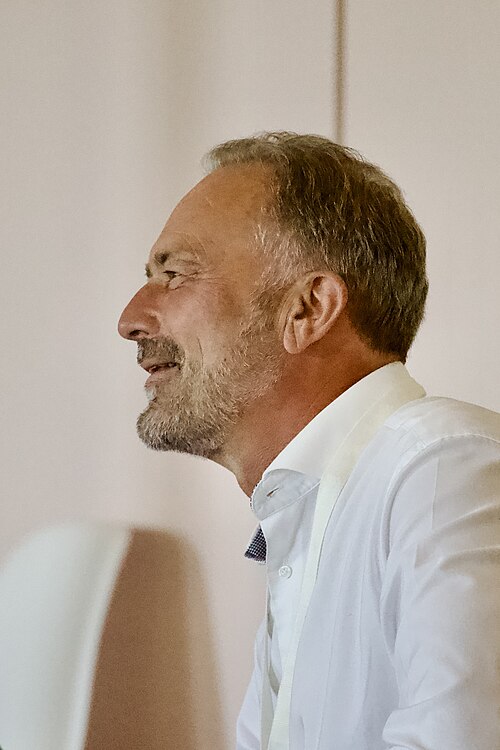
 Barend Mons (born 1957, The Hague) is a molecular biologist and a FAIR data specialist. The first decade of his scientific career he spent on fundamental research on malaria parasites and later on translational research for malaria vaccines. In the year 2000 he switched to advanced data stewardship and (biological) systems analytics. He is most known for innovations in scholarly collaboration, especially nanopublications, and knowledge graph based discovery.
In 2012 Barend was appointed full Professor in biosemantics in the Department of Human Genetics at the Leiden University Medical Center (LUMC) in The Netherlands.[1][2][3] In 2014 he organised the seminal FAIR conference at the Lorentz centre that led to the FAIR data initiative and GO FAIR. In 2015 he was appointed chair of the High Level Expert Group on the European Open Science Cloud.
From 2018 to 2023 Barend was the elected president of CODATA, the affiliated organisation on research data related issues of the International Science Council. He has also been the European representative in the Board on Research Data and Information (BRDI) of the National Academies of Sciences, Engineering, and Medicine in the USA. In 2023 he was also appointed professor at the Leiden Academic Centre for Drug Research.
In 2024, he was appointed as Fellow of the International Science Council. At his retirement in 2024 he was Knighted by the Dutch King in the ‘Order of the Netherlands Lion’, the oldest and highest reward for cultural and scientific contributions to the international society.
Barend is a frequent keynote speaker about FAIR and open science around the world, and continues to participate in various national and international boards.
More about Professor Barend Mons, please refer to https://en.wikipedia.org/wiki/Barend_Mons
Title: The Internet of FAIR data and Services
ABSTRACT:
The 'next generation of the Internet' will have to serve machines much like the current Internet serves people. Preferably we should avoid some of the apparent downsides of the current situation, where a few major players dominate the Internet and the Web. This is why we started the Leiden Initiative for FAIR and Equitable Science, LIFES. In this not for profit, globally oriented association, we connect international members who are ’serious about FAIR and Equitable access to information'. LIFES is a public private partnership composed of Application and Service Providers, Users and Recognised Expert Communities. The latter category is a very important one as it allows existing and new communities with a strong mandate for a particular topic or domain, but also with a regional or national mandate to ’take care’ of the relevant services, standards, tooling and infrastructure in their domain or region. The growing LIFES community formally ‘recognises’ the leading role of a Recognised Expert Community in its domain or region. This minimises the risk for duplication of efforts and reinvention of wheels.
LIFES as an association, connects its members to jointly implement and innovate on outstanding challenges. Next to a rigorous commitment to the FAIR principles for machine actionable data stewardship, LIFES members commit to strive towards global ‘data visiting’, which leaves data at the source wherever possible and makes these data FAIR and visitable by algorithms. This approach mitigates many of the GDPR, privacy and security issues associated with more traditional data sharing and it also allows scientists and innovators from low connectivity areas to fully participate in the Internet of FAIR data and Services.
A discussion will be initiated on how Taiwan and the entire region can optimally participate in this global effort, which also relates to other regional and global opens science commons initiatives such as EOSC, AOSP and GOSC.