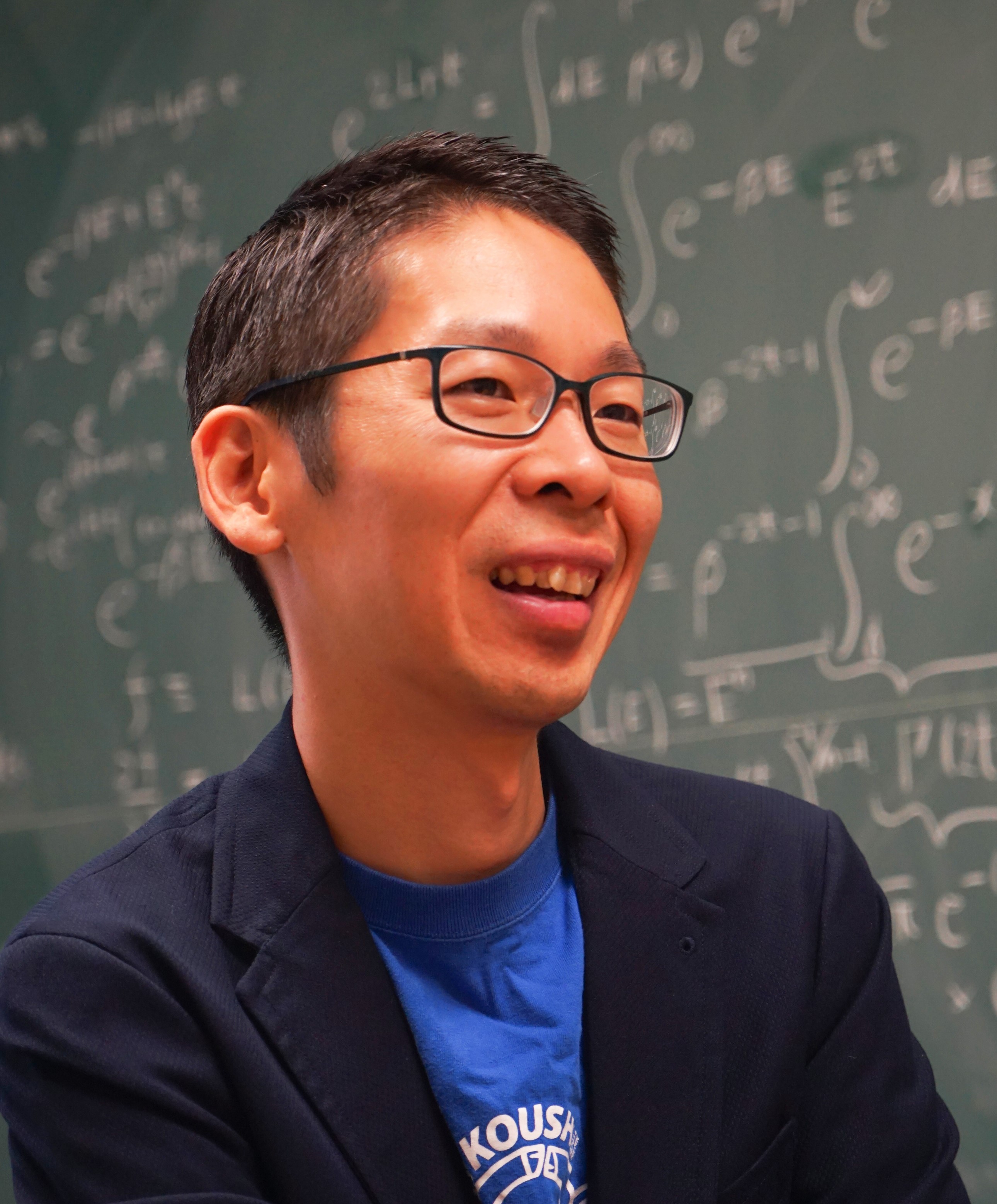
 Professor Koji Hashimoto is a leading theoretical physicist specializing in string theory, quantum gravity, and the interface between machine learning and fundamental physics. He earned his Ph.D. in Physics from Kyoto University in 2000 and has held research positions at the University of California, Santa Barbara; the University of Tokyo and RIKEN. In 2012 he was appointed as a full professor at Osaka University, and since 2021, he has been a professor at the Graduate School of Science, Kyoto University. Professor Hashimoto's research encompasses string theory, holographic principle, and the application of deep learning to theoretical physics. His contribution includes analyses of quantum chaos using out-of-time-order correlators, quantum computational complexity and black holes, and neural networks representing quantum gravity spacetimes. He has authored several influential books, including "D-branes" (Springer, 2012) and "Deep Learning and Physics" (Springer, 2021). As a director he leads the MEXT "Machine Learning Physics" initiative, aiming to integrate AI methodologies with theoretical physics. In addition to his academic work, Professor Hashimoto has contributed to science communication by novels and essays, public lectures, art performance, musical collaboration, and supervising the physics in the film "Shin Ultraman" and the subtitles for "Oppenheimer". His interdisciplinary approach continues to influence both scientific and public understanding of physics.
Title
"Machine Learning Physics" --- an emergent new arena of research unifying AI and quantum physics
Abstract
Machine learning and physics have long been deeply intertwined, and there have been eras when their relationship came to the forefront. Even in today’s revolutionary AI development, physics has played a significant role—for example, in diffusion models. From a physics standpoint as well, an integrative perspective across various specialized domains is provided by innovative new mathematical frameworks, and machine learning serves as one such framework. Launched in fiscal year 2022, the MEXT Scientific Transformation Area Research (A) initiative “Foundation of Machine Learning Physics” was established to forge a new interdisciplinary field merging machine learning and quantum physics in Japan. Now in its fourth year, it has produced a wide range of research outcomes and functions as a central hub where many researchers gather. In this talk, I will introduce the goals of this initiative, illustrating them with specific research examples, and discuss the future relationship between machine learning and quantum physics. The research examples include quantum simulations accelerated by machine learning methods in particle physics, computational physics and condensed matter physics, as well as novel approaches to AI architectures such as quantum interpretation of diffusion models and gravitational symmetries within neural networks.